Cycle Handling in Automation Scenarios
When building automation scenarios, profiles may pass through the same sequence of nodes multiple times — for example, when looping back to previous nodes or using the Jump to Scenario node, which sends a profile to another scenario.
The platform automatically detects such cycles and protects against infinite scenario execution.
What Is a Cycle in a Scenario
A cycle occurs when a profile passes through the same sequence of nodes repeatedly. This can happen when looping back to previously visited nodes, through conditional transitions, or when using the Jump to Scenario node if the profile returns to the original scenario. For example, a profile follows the path A — B — C — A and starts the cycle again.
Cycle Limit
By default, the platform limits the number of repetitions of a single cycle to 20. The platform administrator can change this value in the platform configuration file.
When the limit is reached:
- Task execution for the given profile stops
- An error with the message
Cycle limit of 20 has been reachedwill appear on the last node of the cycle where the profile was at the time of detection - The profile is no longer processed by this scenario
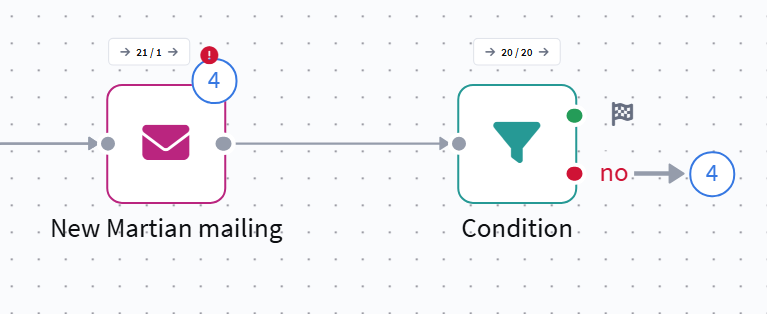
If a profile has hit the cycle limit, check the scenario for incorrect conditions that prevent the profile from exiting the cycle.
When a cycle is repeated (before reaching the limit), the platform automatically adds a delay before re-entering the cycle. For example, if a profile has completed cycle A — B — A, it will wait 60 seconds before the next pass (before node A). The platform administrator can change the delay value.
Cross-Scenario Protection
When transitioning between different scenarios through the Jump to Scenario node, the platform counts how many times a profile has already visited the target scenario. If a profile has visited the same scenario more than 20 times, further transitions are blocked.
This prevents a situation where two scenarios "pass" a profile back and forth infinitely.
Recommendations
- Build exit logic into cycles. When designing scenarios with cycles and backward transitions, make sure the profile has a way to exit the cycle when certain conditions are met.
- Check conditions when the limit error occurs. If a profile has hit the cycle limit, check whether the scenario is stuck in a loop due to incorrect node conditions.
- Avoid mutual transitions between scenarios. If two scenarios pass profiles back and forth through the Jump to Scenario node, make sure the profile has a condition to exit this chain.
When designing scenarios with cycles, it is useful to test them on a small segment of profiles to ensure that profiles pass through and exit the cycle correctly.