Altcraft Docs LogoAltcraft Docs Logo
User guide iconUser guide
Developer guide iconDeveloper guide
Admin guide iconAdmin guide
English
  • Русский
  • English
Login
    User documentation
    Getting Started
    FAQ
    Altcraft glossary
      Profiles and databasesarrow
    • Subscription resources
      Managing databases
      Subscriber profile
      Profiles import and data update
      Scheduled customer data import
      Automatic data collection
      Bulk customers profiles update
      Double opt-in subscription
      Suppression lists
      Profile relations
      Profile history export
      Profile export
      Creating a static segment based on import results
      How to open a CSV file
      Matching
      Types of fields in the database
      Global control groups
      Subscription Manager
      Communication channelsarrow
      • Email channelarrow
      • Email: ISP interactions best practices
        Email: sending domain configuration
        Email: setting up and using postmasters
        Быстрый старт
        Push channelarrow
        • Mobile Pusharrow
        • Settings & implementation
            Integrate your app with Altcraftarrow
          • Providers: push message structure
            Processing and adding a subscription
            Event registration
          Web pusharrow
        • Preliminary Settings
            Web browser push configurationarrow
          • Firebase Cloud messaging
            Apple Safari
            Mozilla Services
          Connecting Web Push to a Website
          Transferring Data to the Platform
          Web Push SDK Methods
            Import of subscriptions from third-party push servicesarrow
          • Migrating push subscriptions from third-party services
            How to transfer push subscriptions configured for Safari?
            Migration from OneSignal
      SMS channel
        Creating mailing from scratcharrow
      • Email
        SMS
        Web Push
        Mobile Push
        WhatsApp
        Viber*™
        Руководство: SMS-рассылка через VK Notify
        MAX Bot
        MAX Group
        Notify
        Telegram Bot
        Telegram Group
      Communication Channels Workflow
      Руководство: SMS-рассылка через УТШ
      Руководство: push-рассылка через сервис от "Согласие"
      Segmentationarrow
    • Static Segments
      Dynamic Segments
      Updatable Segments
        Segmentation Conditionsarrow
      • Segmentation by Profile data
        Segmentation by Interactions with Entities
        Segmentation by Activity of the channel
        Segmentation by external data
        Segmentation by external SQL tables
        Segmentation by Profile structure
      Best Send Time (BST)
      Logical operators "AND" and "OR"
      Recommendations for working with segments
      Message templatesarrow
      • Working with message templatesarrow
      • Working in the editor
        Email-template
        SMS template
        Push template
        MAX template
        Telegram template
        WhatsApp template
        Viber™ template
        Notify template
        Visual editor for email-templatearrow
      • Visual editor interface
        Adding blocks
        Elements and their settings
        Custom blocks
        Style manager
        Layer manager
      Template fragments
      Image gallery
      Content personalization
      Creating tables based on array elements
      Block editor for email template
        Altcraft Variables and Functionsarrow
      • Logical expressions in messages
        Loops in messages
        Market variables in templates
        Using the JSONPath functionality
        Dynamic content in messagesarrow
      • Dynamic HTML content
        Dynamic JSON content
        Content from SQL database in templates
        Dynamic API content
      Importing and exporting a message template
      Importing a template from a third-party service
      Exporting a template from Pixcraft
      Mailingsarrow
    • Mailings calendar
      Broadcast mailings
      Regular mailing
      Trigger mailing
      Multivariate testing
      Mailing testing
      Mailing schedule
      Placement mailing
      Campaignsarrow
    • Working with Campaigns
      Local control groups (LCG)
      Audience expansion
      Audience building
      Automation scenariosarrow
    • Managing scenarios
      Nodes of the scenario
      Classic marketing scenarios
      Step-by-step welcome scenario guide
      Scenario for automatic notification of the manager
      Abandoned cart scenario
      Marketarrow
    • Market settings
        Productsarrow
      • How to create a product manually
        How to import a product from a file
        Scheduled product import
        Product and SKU Segments
        Preparing the YML file
      Orders
      Market variables in message template
      Guide: how to send an order confirmation email
      Loyalty programsarrow
    • Loyalty programs
      Loyalty integration with external systems
      Быстрый старт
      Basic loyalty program use cases
      Order Segments
      Promotion codes
      Reports and analyticsarrow
    • Channel report
      Traffic report
        Summary reportarrow
      • Summary report metrics
      Cohorts report
      Lifetime report
      Funnels report
      Goals report
      Audience growth report
      Click map report
      Loyalty programs report
      Bounces report
      Undeliveries report
      Report on global control groups
      Integrationsarrow
      • Action hooksarrow
      • Altcraft Action Hooks
        Action hooks event types
        Action Hook Message Structure
        JSON batch request (HTTP POST action hook)
        Message to RabbitMQ broker
        Message to RabbitMQ exchanger
        Message to Kafka broker
        Test event
        Integration of third-party services using Albatoarrow
      • Connecting Altcraft to Albato
        Launching the welcome scenario using Albato
        Transmitting event data
        Setting app a trigger mailing
        Event registration
        Google Sheets and Altcraft integration
        AmoCRM and Altcraft integration
      Facebook Ads Manager™
      Google Ads Audiences
      MAX
      Yandex.Audience™
      VK Ads™
      Static segment synchronization
      Yandex AppMetrica™
      Tilda™
      Lpgenerator™
      WhatsApp
      Viber*™ integration
      Integration scope
      Data Transmitted During Synchronization
      Notify
      Weblayersarrow
      • Formsarrow
      • Create a form
        Form constructor
        Appearance
        Actions after form activation
        Data analytics
        Binding data channel and forms
        Conditional logic in forms and surveys
        NPS testing
        Pixelsarrow
      • Goal customer actions and scoring
        Pop-upsarrow
      • Creating and publishing a pop-up
        Setting up a popup in the code editor
        Managing pop-ups manually via script
        Popup analytics
        Guide: pop-up for push subscriptions
        Case: Creating a pop-up with the "Wheel of Fortune" widget
        Basic cases of placing a popup via the Tag Manager
        Tag Managerarrow
      • Configuring and installing Tag Manager
        Trigger types
        Variables types
        Linking a pixel and the Tag manager
      Settingsarrow
    • Account settings
      Custom links
      Virtual senders
      Sending policies
      Audit journal
      Tags FAQ
        Users, groups and accessarrow
      • Two-Factor Authentication (2FA)
        Connectionsarrow
      • Connection to Facebook Ads Manager
        Connection to Google Ads
        Connecting to Yandex.Audience™
        Connection to 360dialog
        Connection to Edna
        Connection to Devino Telecom
        Connection to SMSTraffic
        Connection to VK Ads™
        Connection to MTS OmniChannel
        Custom Authentication Connection
        OAuth2 connection
        Basic Authentication connection
        Token Authentication connection
        Connection to Rapporto
        MAX connection
        Connection to Notify
      Attribute settings
      API requests: where to startarrow
    • Import or update a profile
      Trigger mailing launch
      Engage profile in scenario
      Changelogarrow
    • v2026.1.76
      v2025.4.75
      v2025.4.74
      v2025.3.73
      v2025.2.72
      v2025.1.71
      v2024.4.70
      v2024.3.69
      v2024.2.68.2
      v2024.1.68
    Documentation archive
    library
  • Settings
  • Virtual senders

Virtual senders

Overview​

A virtual sender is a set of rules for real senders and a powerful tool for fine messaging tuning.

Your delivery rate can greatly depend on it — especially with large amounts of messages to be sent.

These rules specify real sender usage proportions and custom From and Reply-to email fields for messages sent.

note

Virtual senders can be created and managed only by a master user or an Altcraft platform administrator.

If you need to manage the virtual senders of your account, in the main menu, select Settings —> Virtual senders. Click + New to add a sender.

You can enable virtual senders for mailings if Smart settings are available for your account. If Smart settings are not available, the first valid virtual sender will be used.

General settings​

First of all, you need to enter a unique name for each sender:

You can set groups in the bottom of the page. These groups will get access to the virtual sender.

Sending rules for different communication channels​

Rules for email senders

The rules for email senders determine which real senders and in what proportions will be used under certain conditions. To add a rule, click + Add Rule.

Select the appropriate condition from the drop-down menu When the rule is applied:

  • Match by group — the rule will be applied to mailings within a group specified for matching.

  • Match by "From domain" — the rule is applied when sending from a specific domain.

  • Match by "To domain" — the rule is applied when sending to specific email domains.

  • Match by "From email" — the rule is applied when sending from a specific email address.

  • Default (match all) — no conditions are required for this rule to be activated. It will be applied by default whenever a current virtual sender is set for a mailing.
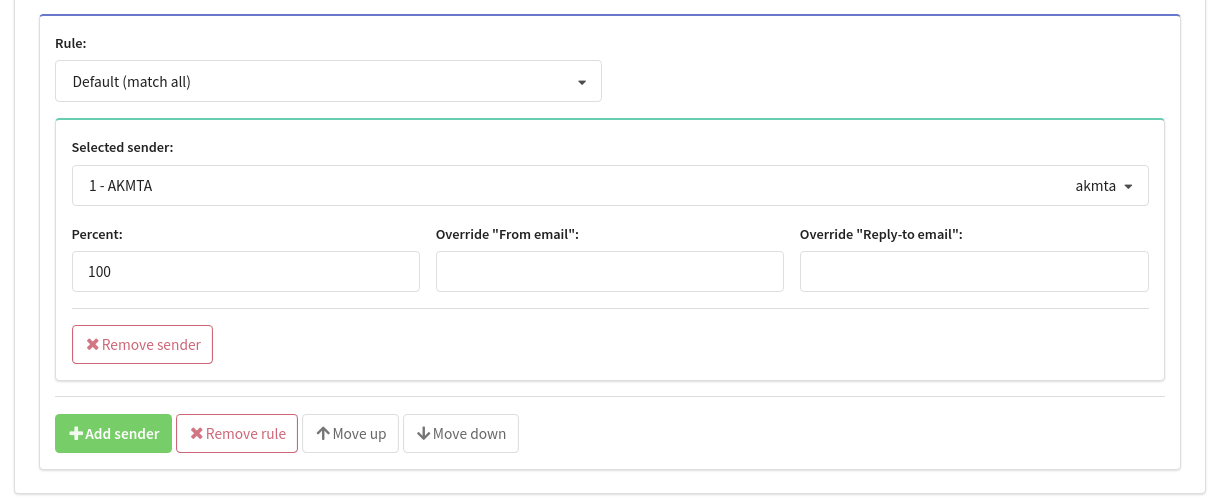
You can create multiple rules and sender options. The priority of applying rules is set by their position on the page: from top to bottom. The Default rule (match all) must be the last one in the list. The priority of other rules is set using the Move Up and Move Down buttons.

caution

The Default rule (match all) is not possible to delete or move up in priority, since it handles all cases that do not fall under the other rules.

Using the Add sender and Remove rule buttons, you can add and remove senders within the sending rule. The following fields are configured for each sender:

  • Selected sender — select a real sender for sending.

  • Percent — set for the sender the percentage of messages sent within the rule.

  • Override "From Email" — override the "From email value" for outgoing messages.

  • Override "Reply-to Email" — override the "Reply-to email" value for outgoing messages.

note

For one rule the sum of senders usage percent must be 100.

Rules for SMS senders

The rules for SMS senders determine which real senders and in what proportions will be used under certain conditions. To add a rule, click + Add Rule.

Select the appropriate condition from the dropdown menu with rules:

  • Match by group — the rule will be applied to mailings within a group specified for matching.

  • Default (match all) — no conditions are required for this rule to be activated. It will be applied by default whenever a current virtual sender is set for a mailing.
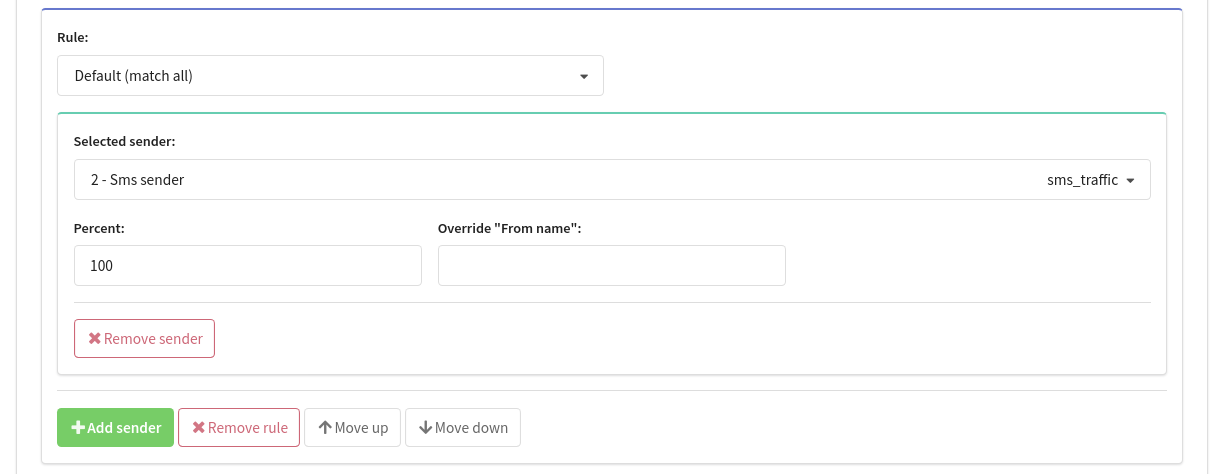
You can create multiple rules and sender options. The priority of applying rules is set by their position on the page: from top to bottom. The Default rule (match all) must be the last one in the list. The priority of other rules is set using the Move Up and Move Down buttons.

caution

The Default rule (match all) is not possible to delete or move up in priority, since it handles all cases that do not fall under the other rules.

Using the Add sender and Remove rule buttons, you can add and remove senders within the sending rule. The following fields are configured for each sender:

  • Selected sender — select a real sender for sending.

  • Percent — set for the sender the percentage of messages sent within the rule.

  • Override "From name" — override the "Caller_ID" value for outgoing messages.

note

For one rule the sum of senders usage percent must be 100.

Rules for push senders

The rules for SMS senders determine which real senders and in what proportions will be used under certain conditions. To add a rule, click + Add Rule.

Select the appropriate condition from the dropdown menu with rules:

  • Match by group — the rule will be applied to mailings within a group specified for matching.

  • Default (match all) — no conditions are required for this rule to be activated. It will be applied by default whenever a current virtual sender is set for a mailing.
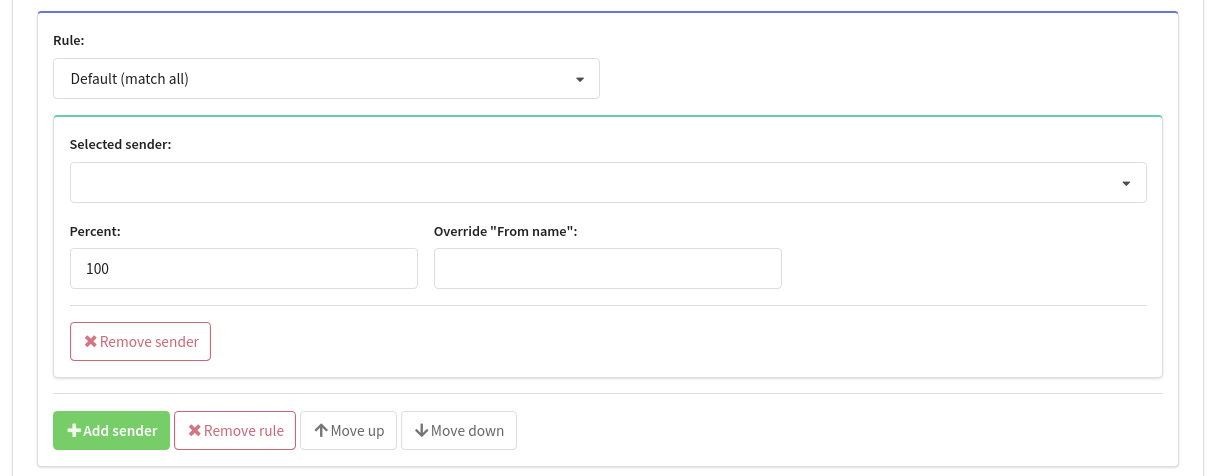
You can create multiple rules and sender options. The priority of applying rules is set by their position on the page: from top to bottom. The Default rule (match all) must be the last one in the list. The priority of other rules is set using the Move Up and Move Down buttons.

caution

The Default rule (match all) is not possible to delete or move up in priority, since it handles all cases that do not fall under the other rules.

Using the Add sender and Remove rule buttons, you can add and remove senders within the sending rule. The following fields are configured for each sender:

  • Selected sender — select a real sender for sending.

  • Percent — set for the sender the percentage of messages sent within the rule.

  • Override "From name" — override the "From name" value for outgoing messages.

note

For one rule the sum of senders usage percent must be 100.

Last updated on Mar 12, 2026
Previous
Custom links
Next
Sending policies
  • Overview
  • General settings
  • Sending rules for different communication channels
© 2015 - 2026 Altcraft, LLC. All rights reserved.