Altcraft Docs LogoAltcraft Docs Logo
User guide iconUser guide
Developer guide iconDeveloper guide
Admin guide iconAdmin guide
English
  • Русский
  • English
Login
    User documentationGetting StartedFAQAltcraft glossary
      Profiles and databasesarrow
    • Subscription resourcesManaging databasesSubscriber profileProfiles import and data updateCommon Errors When Importing ProfilesScheduled customer data importManaging Data TablesAutomatic data collectionBulk customers profiles updateDouble opt-in subscriptionSuppression listsProfile relationsProfile history exportProfile exportCreating a static segment based on import resultsHow to open a CSV fileMatchingTypes of fields in the databaseGlobal control groupsSubscription Manager
      Communication channelsarrow
      • Email channelarrow
      • Email: ISP interactions best practices
          First mailingarrow
        • Quick StartEmail
        Email: sending domain configurationEmail: setting up and using postmasters
        Push Channelarrow
        • Mobile Pusharrow
        • First Mobile Push MailingНастройка и подключение
            Провайдеры Mobile Pusharrow
          • Apple Push Notification ServiceYandex.AppMetricaFirebase Cloud MessagingHuawei Mobile ServicesRuStore
            Integrate your app with Altcraftarrow
          • Обработка и добавление подпискиРегистрация событийПровайдеры: структура push-сообщения
          Web Pusharrow
        • First Web Push MailingResource and Website Setup
            Web Push Providersarrow
          • Firebase Cloud messagingApple SafariMozilla Services
          Transferring Data to the PlatformWeb Push SDK MethodsPWA and Push Notifications
            Migration and Subscription Transferarrow
          • Migrating push subscriptions from third-party servicesHow to transfer push subscriptions configured for Safari?Migration from OneSignal
        SMS channelarrow
      • SMS
      WhatsAppViber*™
        Telegramarrow
      • Telegram BotTelegram Group
        Maxarrow
      • MAX BotMAX Group
      NotifyCommunication Channels WorkflowРуководство: SMS-рассылка через VK NotifyРуководство: SMS-рассылка через УТШРуководство: push-рассылка через сервис от "Согласие"
      Segmentationarrow
    • Static SegmentsDynamic SegmentsUpdatable Segments
        Segmentation Conditionsarrow
      • Segmentation by Profile dataSegmentation by Interactions with EntitiesSegmentation by Activity of the channelSegmentation by external dataSegmentation by external SQL tablesSegmentation by Profile structure
      Best Send Time (BST)Logical operators "AND" and "OR"Recommendations for working with segments
      Message templatesarrow
      • Working with message templatesarrow
      • Working in the editorEmail templateSMS templatePush templateMAX templateTelegram templateWhatsApp templateViber templateNotify template
        Visual editor for email-templatearrow
      • Visual editor interfaceAdding blocksElements and their settingsCustom blocksStyle managerLayer manager
      Template fragmentsImage galleryContent personalizationCreating tables based on array elementsBlock editor for email template
        Altcraft Variables and Functionsarrow
      • Logical expressions in messagesLoops in messagesMarket variables in templatesUsing the JSONPath functionality
        Dynamic content in messagesarrow
      • Dynamic HTML contentDynamic JSON contentContent from SQL database in templatesDynamic API content
      Importing and exporting a message templateImporting a template from a third-party serviceExporting a template from Pixcraft
      Mailingsarrow
    • Mailings calendarBroadcast mailingsRegular mailingTrigger mailingMultivariate testingMailing testingMailing schedulePlacement mailing
      Automation scenariosarrow
    • Managing scenariosNodes of the scenarioClassic marketing scenariosStep-by-step welcome scenario guideScenario for automatic notification of the managerAbandoned cart scenario
      Marketarrow
    • Market settings
        Productsarrow
      • How to create a product manuallyHow to import a product from a fileScheduled product importProduct and SKU SegmentsPreparing the YML file
      OrdersMarket variables in message templateGuide: how to send an order confirmation email
      Loyalty programsarrow
    • Loyalty programsLoyalty integration with external systemsCreating a loyalty program from scratchBasic loyalty program use casesOrder SegmentsPromotion codes
      Reports and analyticsarrow
    • Channel reportTraffic report
        Summary reportarrow
      • Summary report metrics
      Cohorts reportLifetime reportFunnels reportGoals reportAudience growth reportClick map reportLoyalty programs reportBounces reportUndeliveries reportReport on global control groups
      Integrationsarrow
      • Action hooksarrow
      • Altcraft Action HooksAction hooks event typesAction Hook Message StructureJSON batch request (HTTP POST action hook)Message to RabbitMQ brokerMessage to RabbitMQ exchangerMessage to Kafka brokerTest event
        Integration of third-party services using Albatoarrow
      • Connecting Altcraft to Albato Launching the welcome scenario using AlbatoTransmitting event dataSetting up a trigger mailingEvent registrationGoogle Sheets and Altcraft integration AmoCRM and Altcraft integration
      Facebook Ads Manager™Google Ads AudiencesMAXYandex.Audience™VK AdsStatic segment synchronizationYandex AppMetrica™Tilda™Lpgenerator™WhatsAppViber integrationIntegration scopeData Transmitted During SynchronizationNotify
      Weblayersarrow
      • Formsarrow
        • Create a formarrow
        • General settingsForm constructorAppearanceActions and form publicationConditional logic in forms and surveys
        Data analyticsBinding data channel and formsNPS testing
        Pixelsarrow
      • Goal customer actions and scoring
        Pop-upsarrow
      • Creating and publishing a pop-upSetting up a popup in the code editorManaging pop-ups manually via scriptPopup analyticsGuide: pop-up for push subscriptionsCase: Creating a pop-up with the "Wheel of Fortune" widgetBasic cases of placing a popup via the Tag Manager
        Tag Managerarrow
      • Configuring and installing Tag ManagerTrigger typesVariable typesLinking a pixel and the Tag manager
      Settingsarrow
    • Account settingsCustom linksVirtual sendersSending policiesAudit journalTags FAQ
        Users, groups and accessarrow
      • Two-Factor Authentication (2FA)
        Connectionsarrow
      • Connection to Facebook Ads ManagerConnection to Google AdsConnecting to Yandex.Audience™Connection to 360dialogConnection to EdnaConnection to Devino TelecomConnection to SMSTrafficConnection to VK Ads™Connection to MTS OmniChannelCustom Authentication ConnectionOAuth2 connectionBasic Authentication connectionToken Authentication connectionConnection to RapportoMAX connectionConnection to Notify
      Attribute settings
      API requests: where to startarrow
    • Import or update a profileTrigger mailing launchEngage profile in scenario
      Changelogarrow
    • v2026.2.77v2026.1.76v2025.4.75v2025.4.74v2025.3.73v2025.2.72v2025.1.71v2024.4.70v2024.3.69v2024.2.68.2v2024.1.68
    Documentation archiveEmail Marketer's Library
      Campaignsarrow
    • Working with CampaignsLocal control groups (LCG)Stratification Violation ErrorAudience expansionAudience building
  • Communication channels
  • Push Channel
  • Web Push
  • Web Push Providers
  • Apple Safari

Apple Safari

To send Web Push to the Safari browser, you must first set up an Apple Push Notification Service project.

caution

All actions are performed on a macOS device. An Apple Developer account is required for setup.


Step 1. Register Website Push ID​

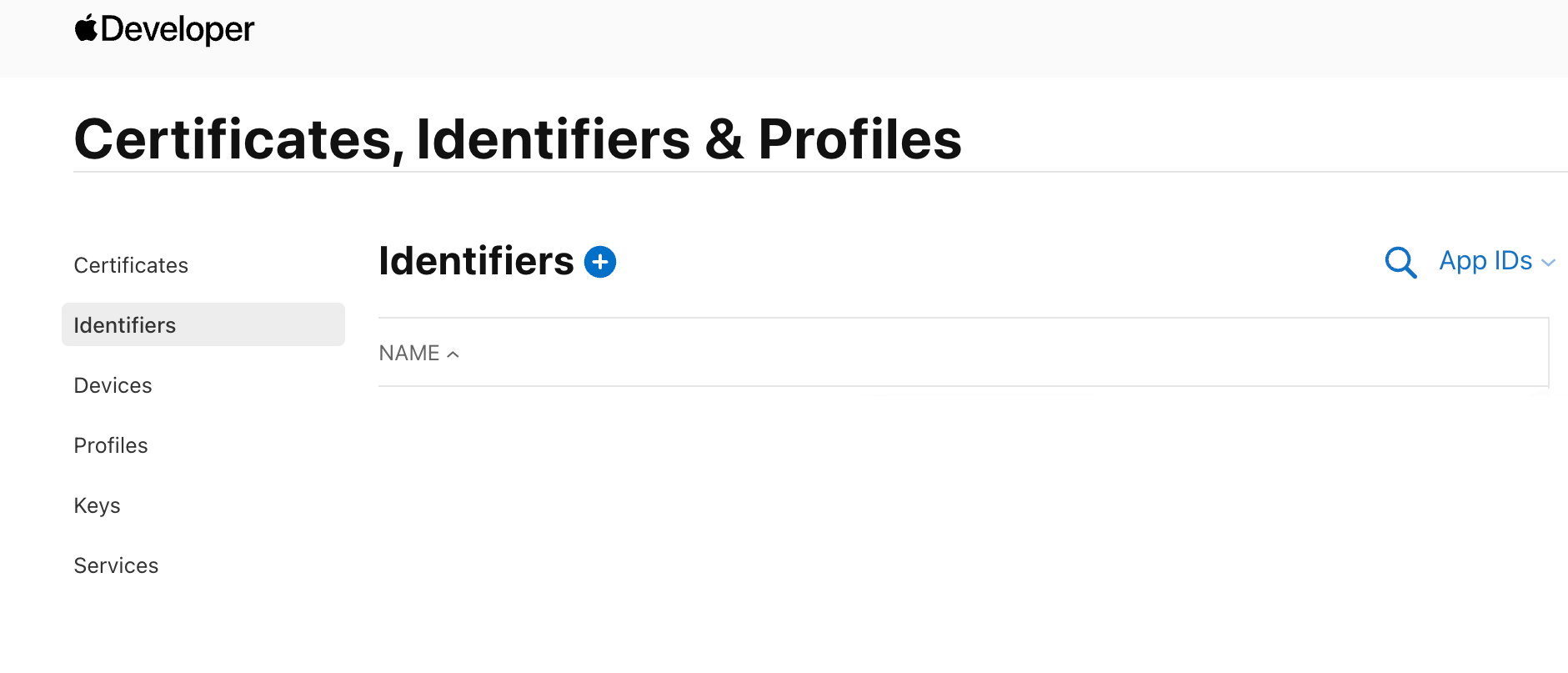
Go to the Certificates, Identifiers & Profiles page and log in to your Apple developer account.

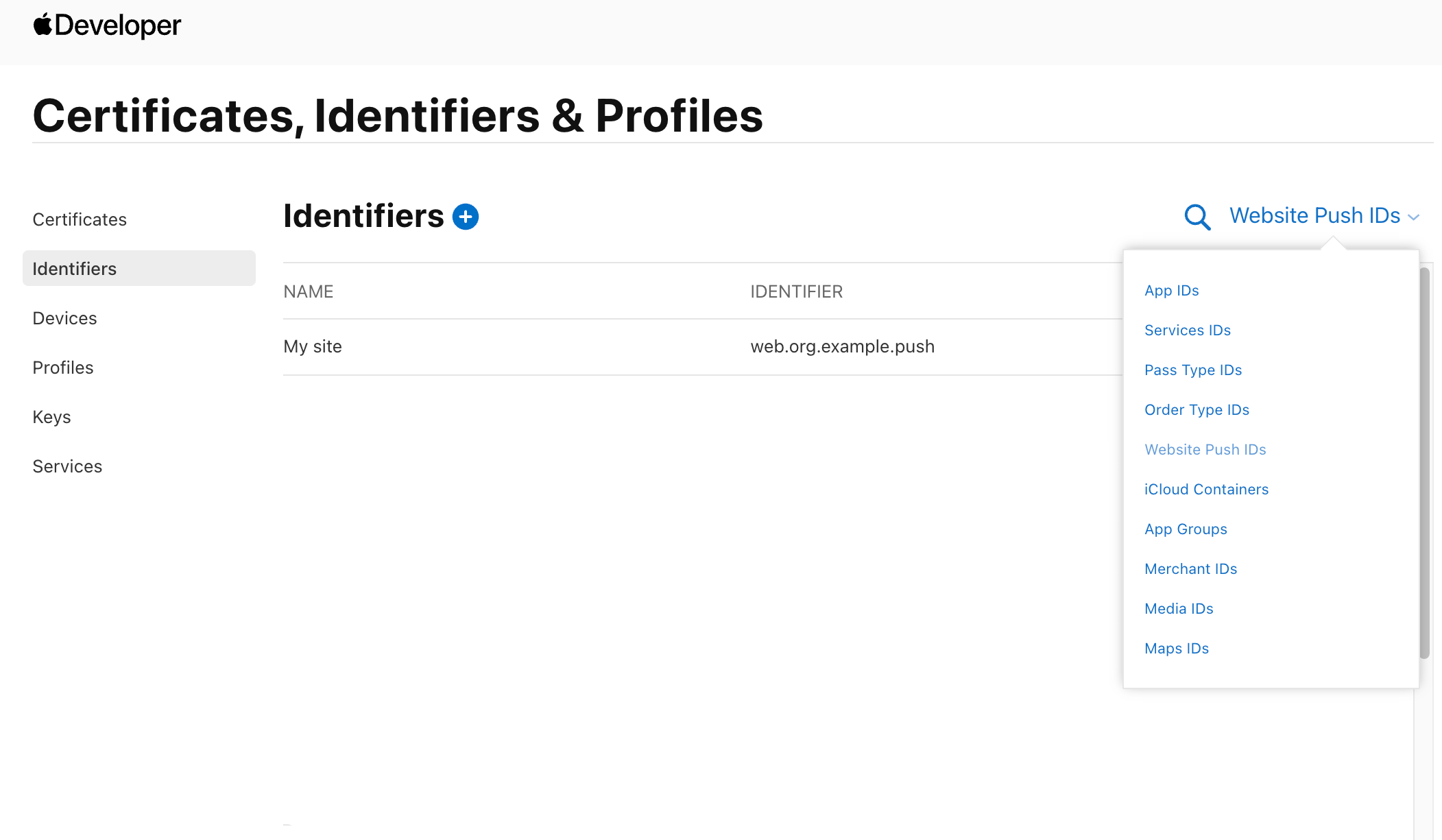
In the left navigation panel, select Identifiers and click + next to the heading.


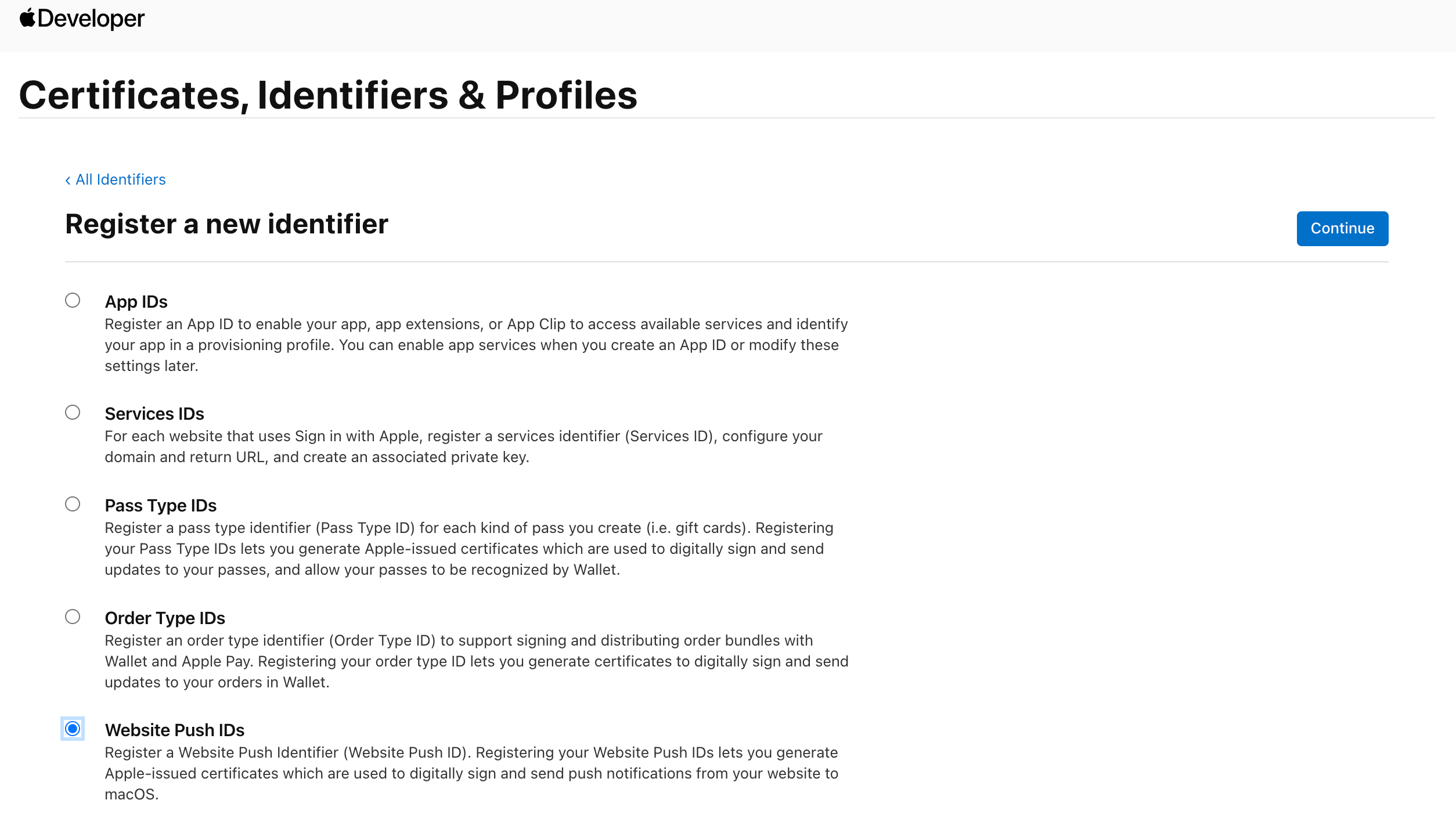
In the window that opens, select Website Push IDs. Click Continue.


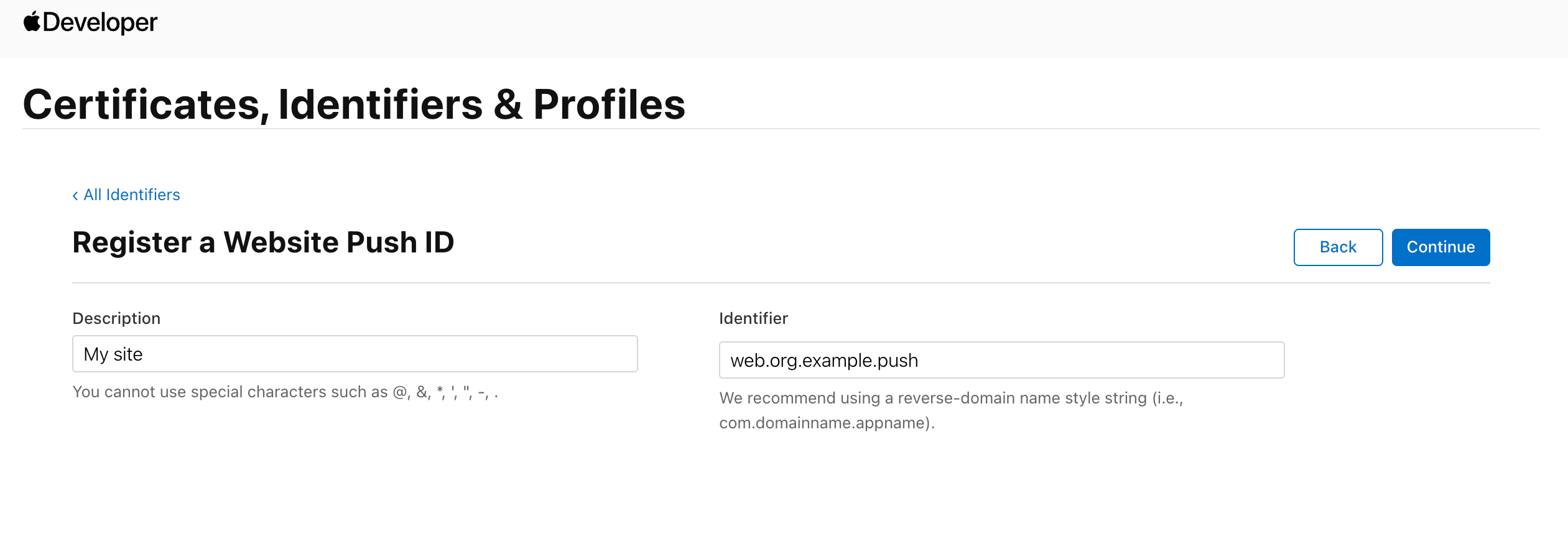
Enter the Description and Identifier.

The identifier must have the format web.com.domainname.appname. The first part is always web. It is recommended to use the reverse domain style, for example, web.org.example.push.

Click Continue.


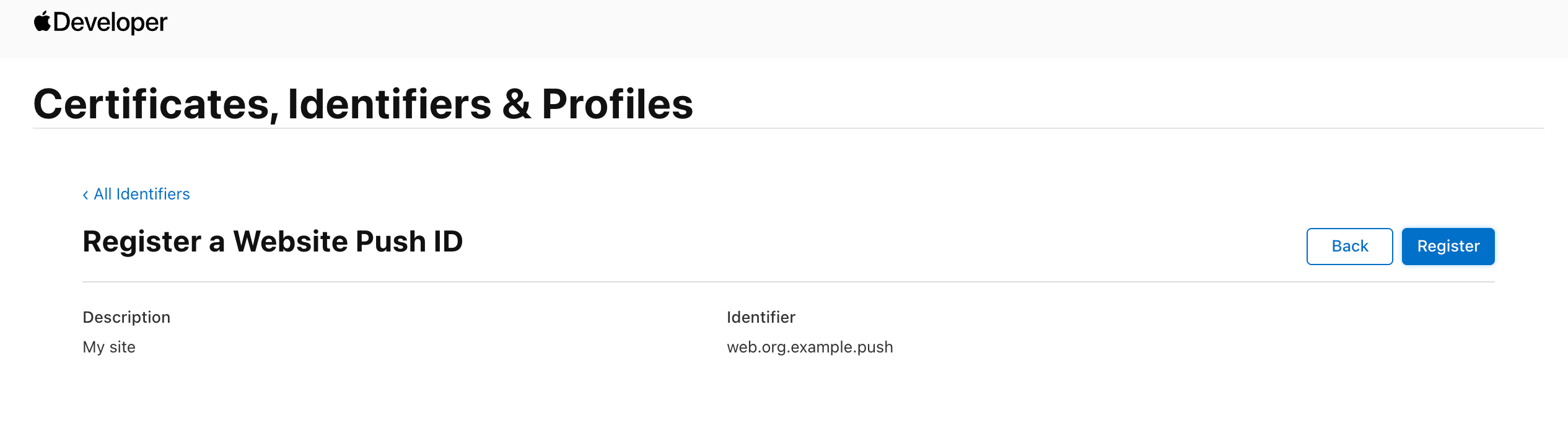
Register the Website Push ID by clicking Register.


The Website Push ID is created and registered. To view information about the identifier on the Identifiers tab, open the drop-down list in the upper right corner and select Website Push IDs.


Step 2. Creating a Certificate​

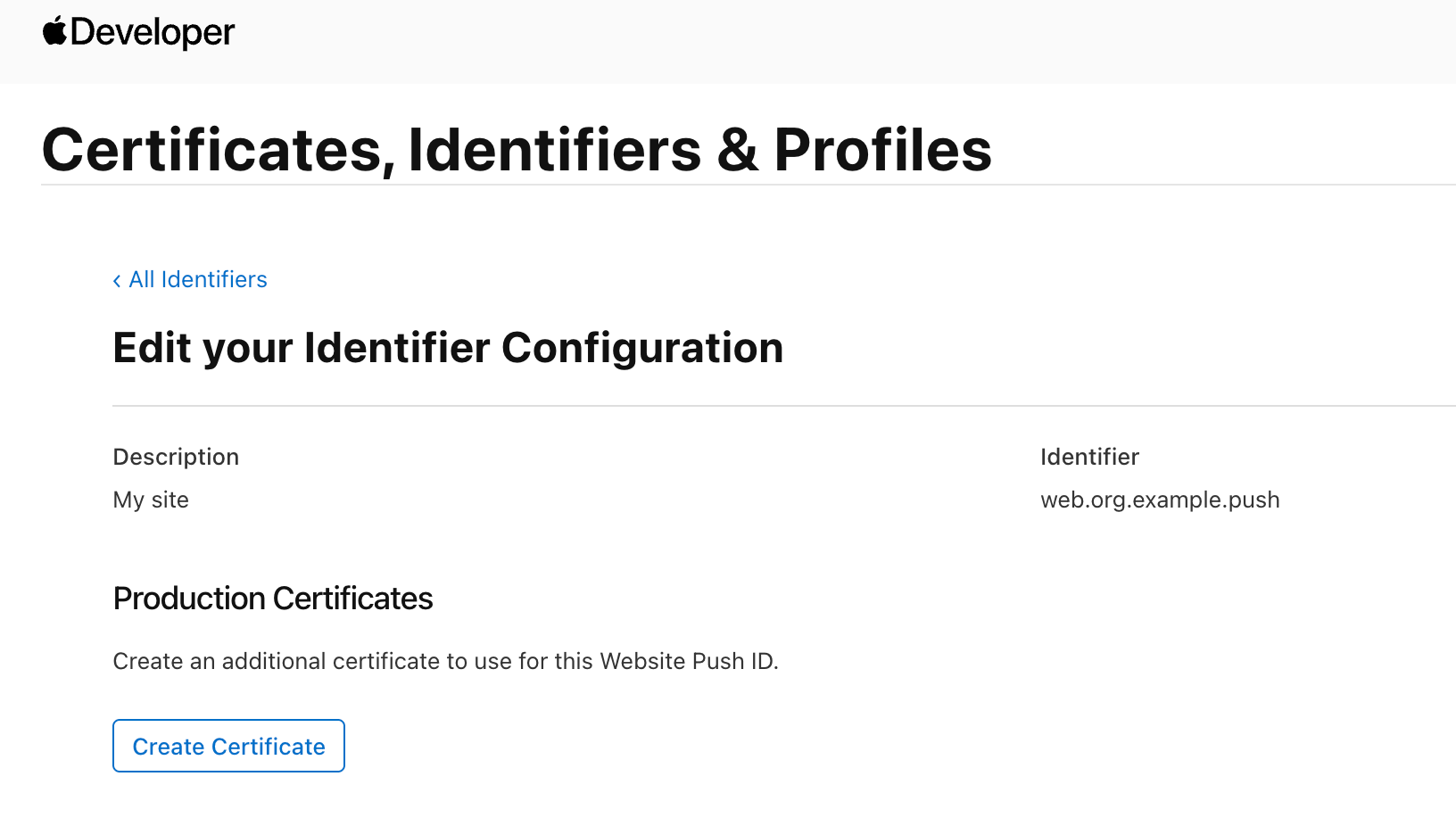
Find the created Website Push ID in the list and click on it. Note the Identifier field — this value will be required when setting up the resource in the Altcraft Platform.

Click Create Certificate.


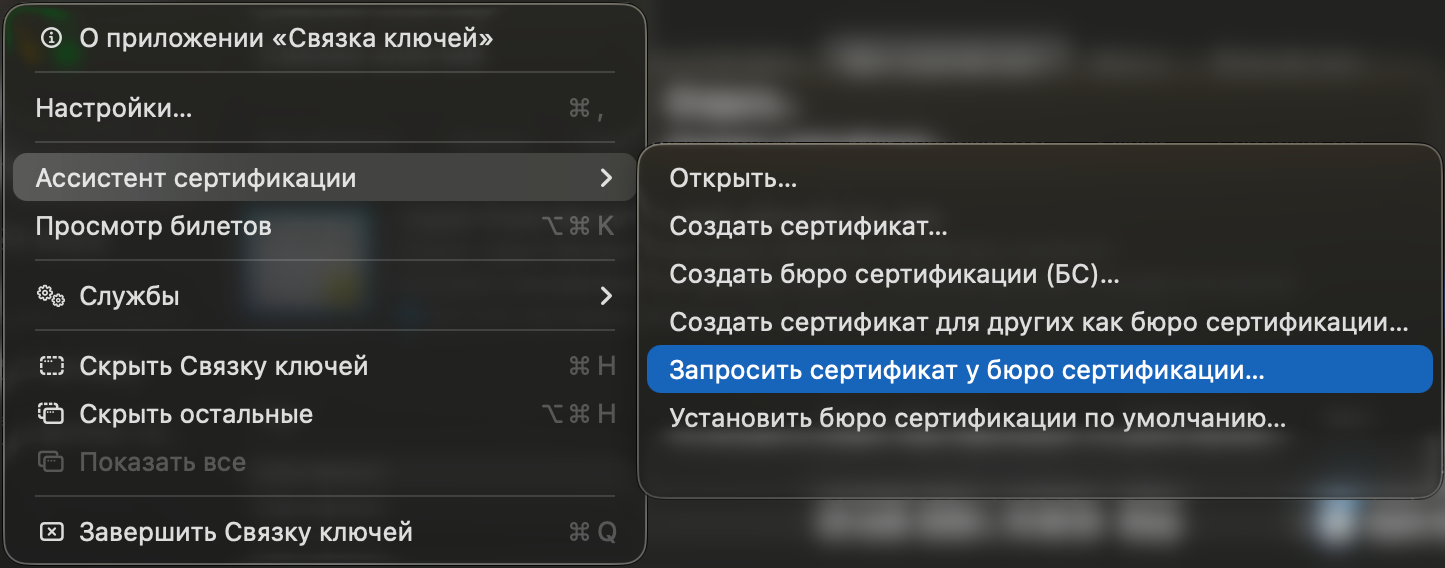
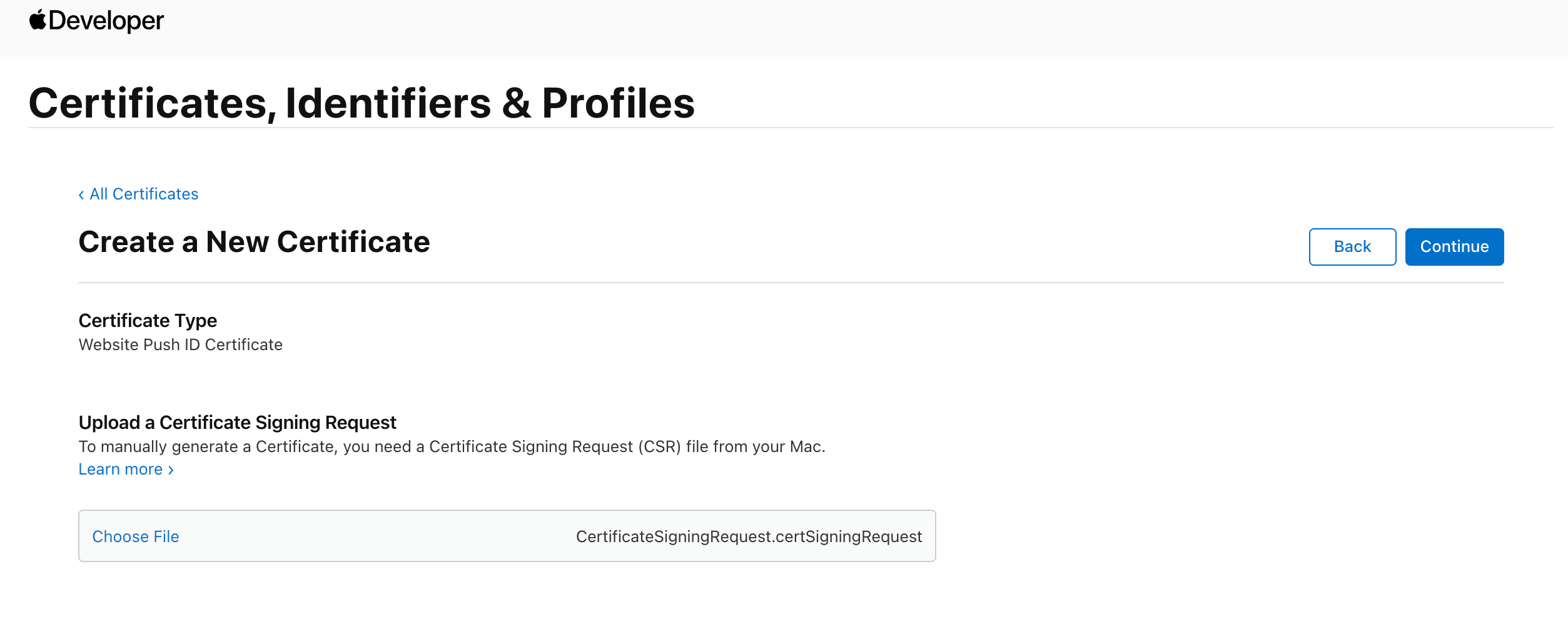
To generate a certificate, you need a Certificate Signing Request (CSR) file with the .certSigningRequest extension. To create it, open the Keychain Access application on your macOS.

Go to Keychain Access — Certificate Assistant — Request a Certificate from a Certificate Authority.


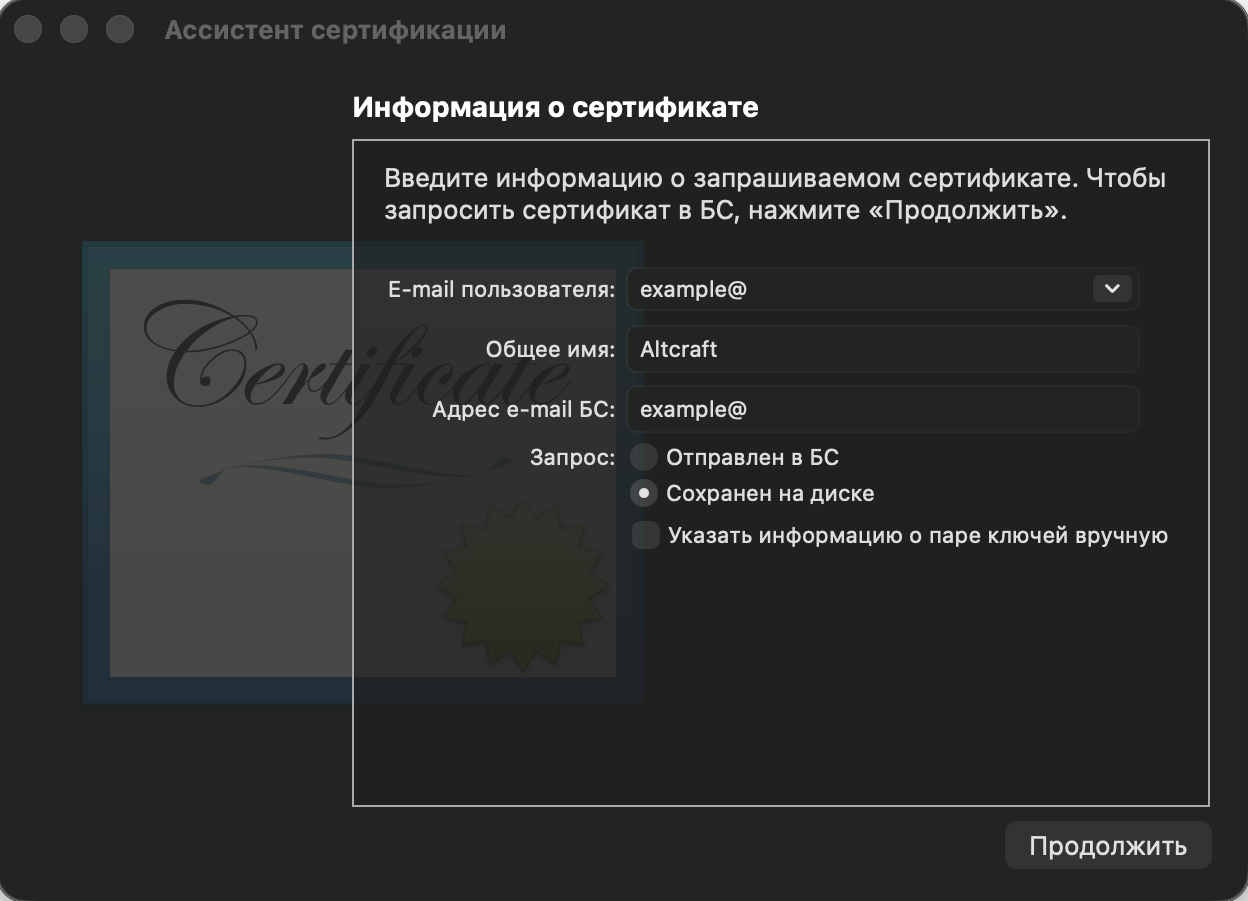
Fill in the certificate information and be sure to select the Saved to disk option. Click Continue — the application will prompt you to save the CSR file to the device.


Return to the Apple Developer website, upload the created CSR file, and click Continue.


Step 3. Saving the Push Certificate​

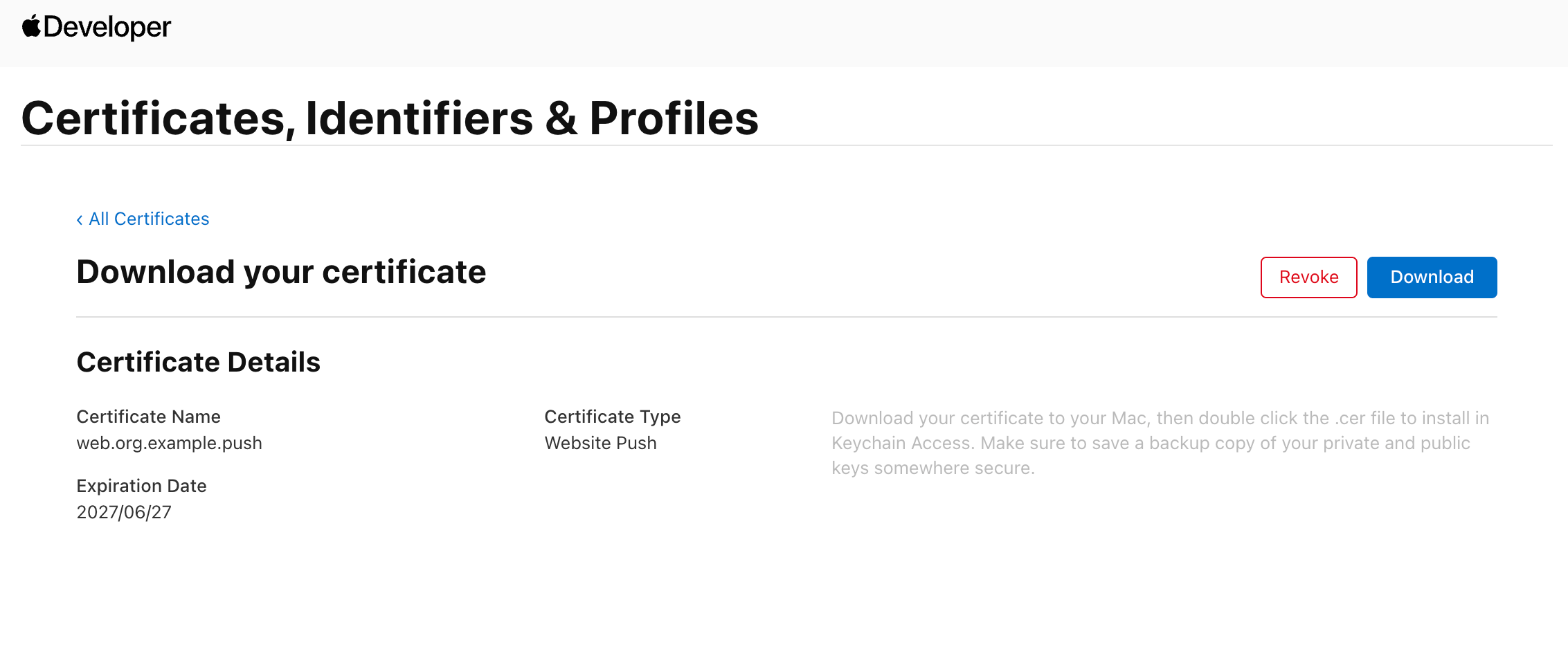
Click Download to download the certificate in .cer format.


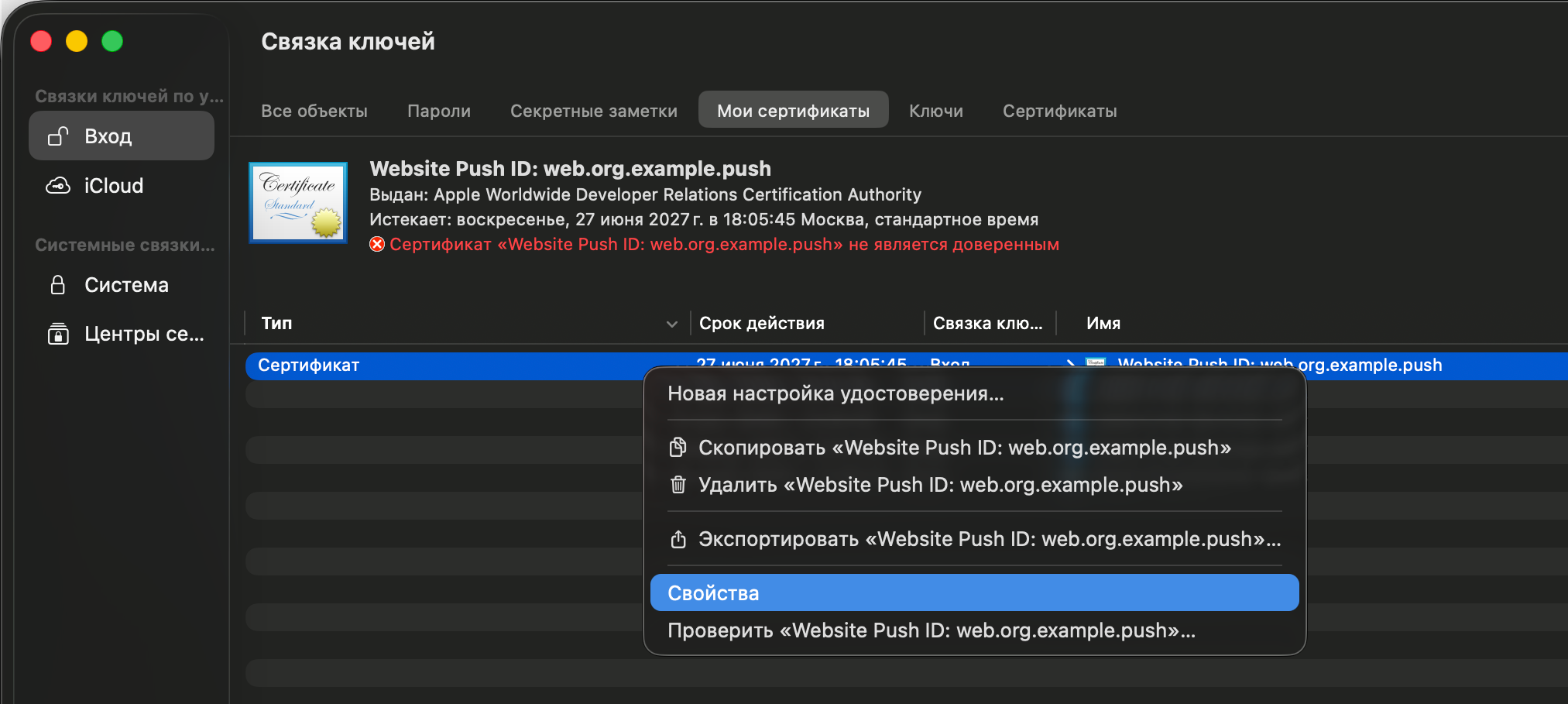
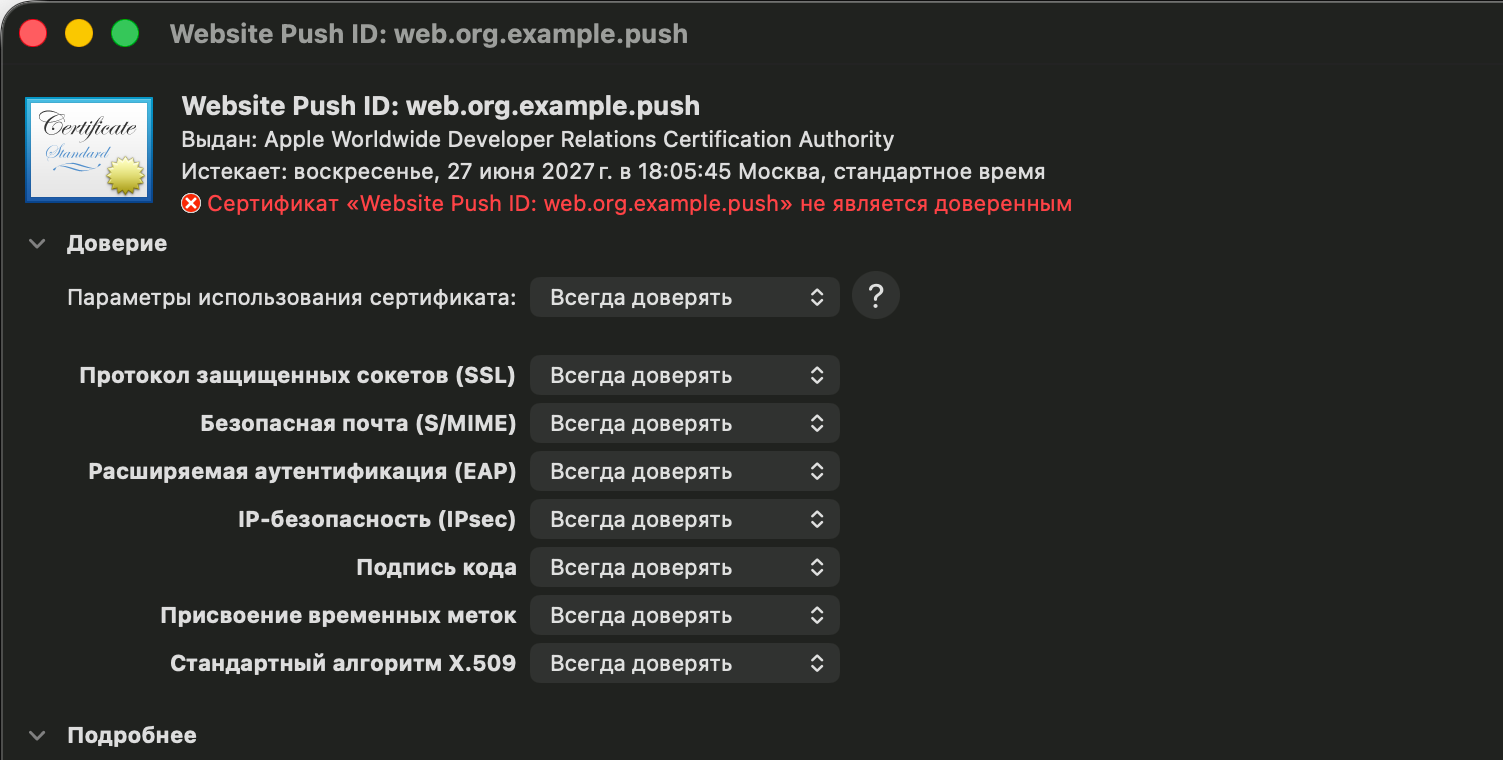
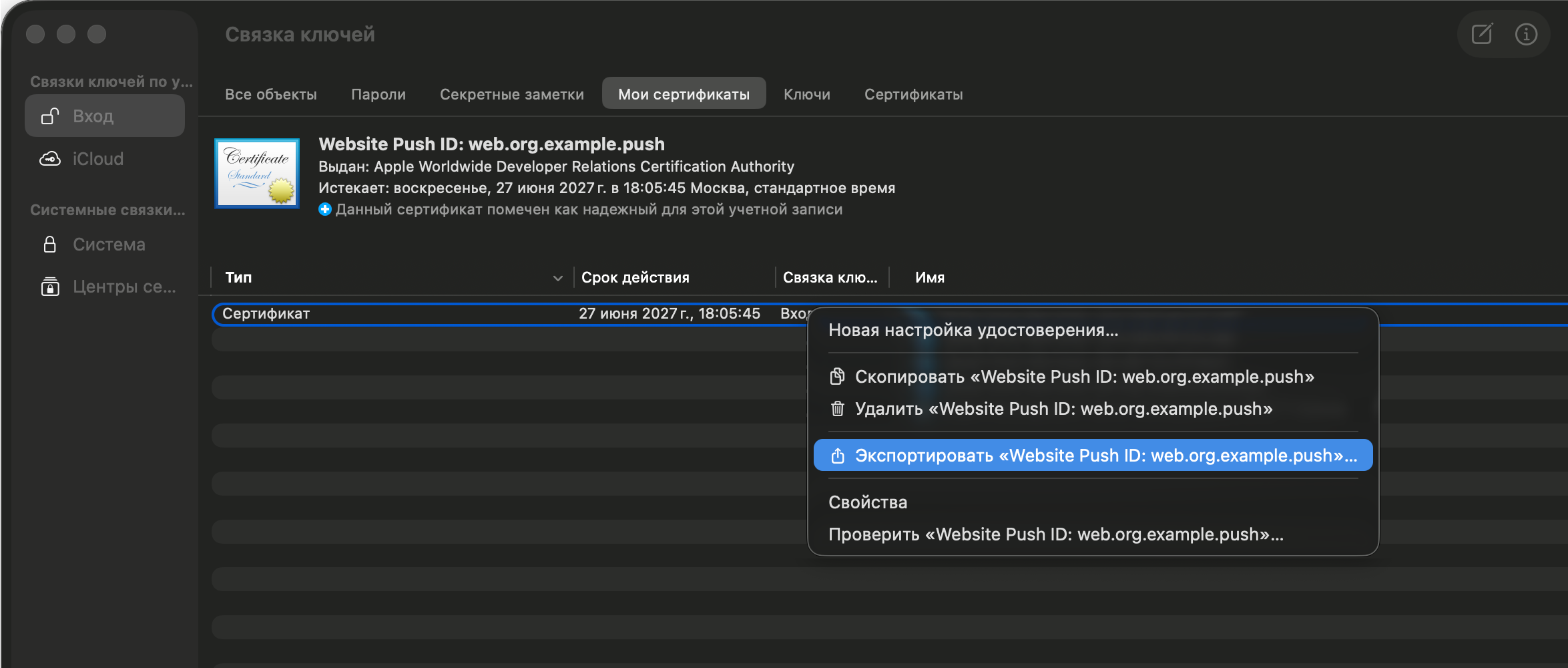
Find the downloaded file and double-click it to open the certificate in Keychain Access. Go to its properties.


Set the trust level for each parameter to Always Trust.


Right-click the certificate and select Export to save it in .p12 format.

Enter a password for the .p12 file. Remember it — it will be required when setting up the resource in the Altcraft Platform.


Step 4. Setting Up in the Altcraft Platform​

Return to the Altcraft Platform and open the resource settings. Go to the push channel settings.

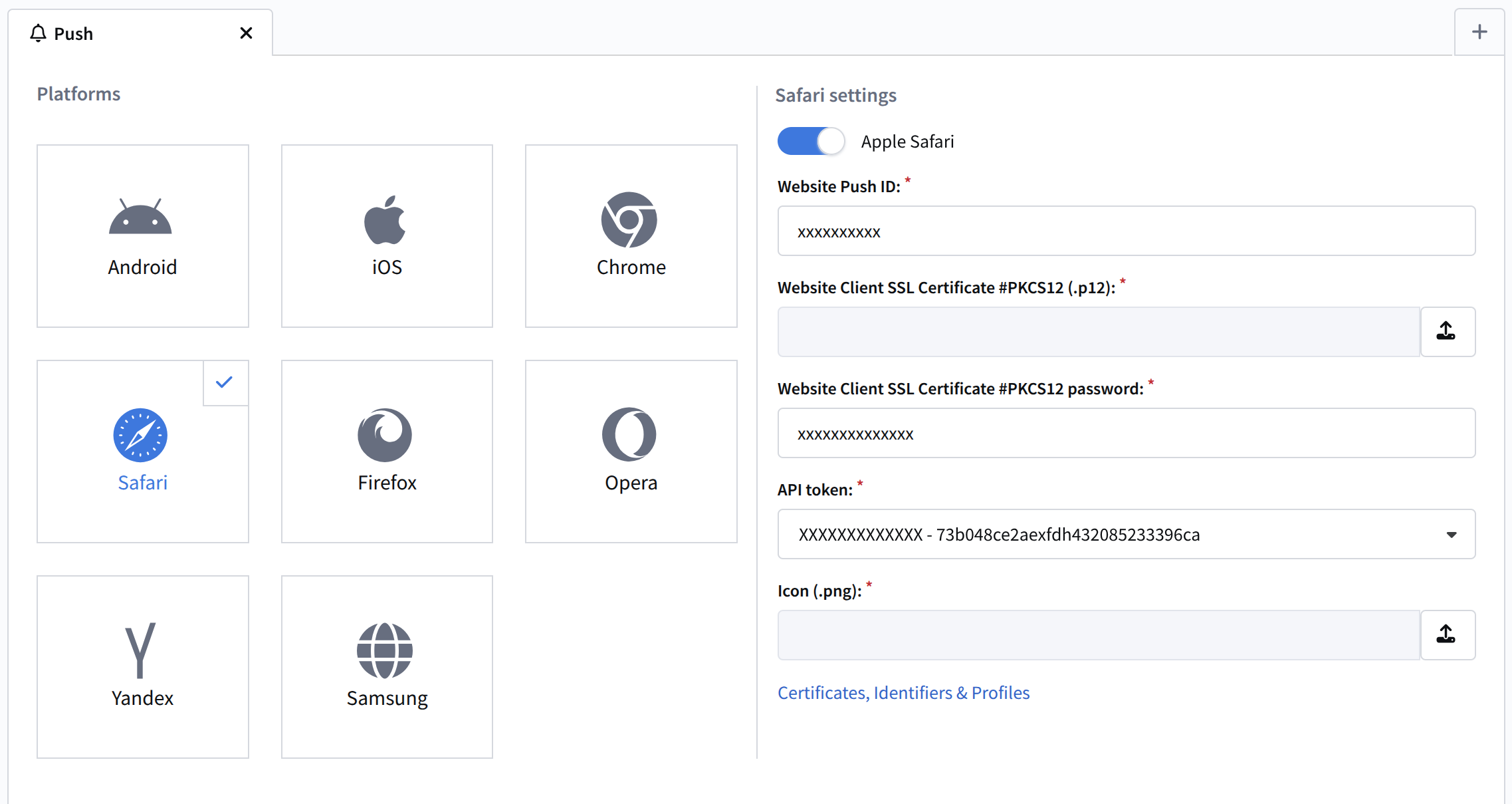
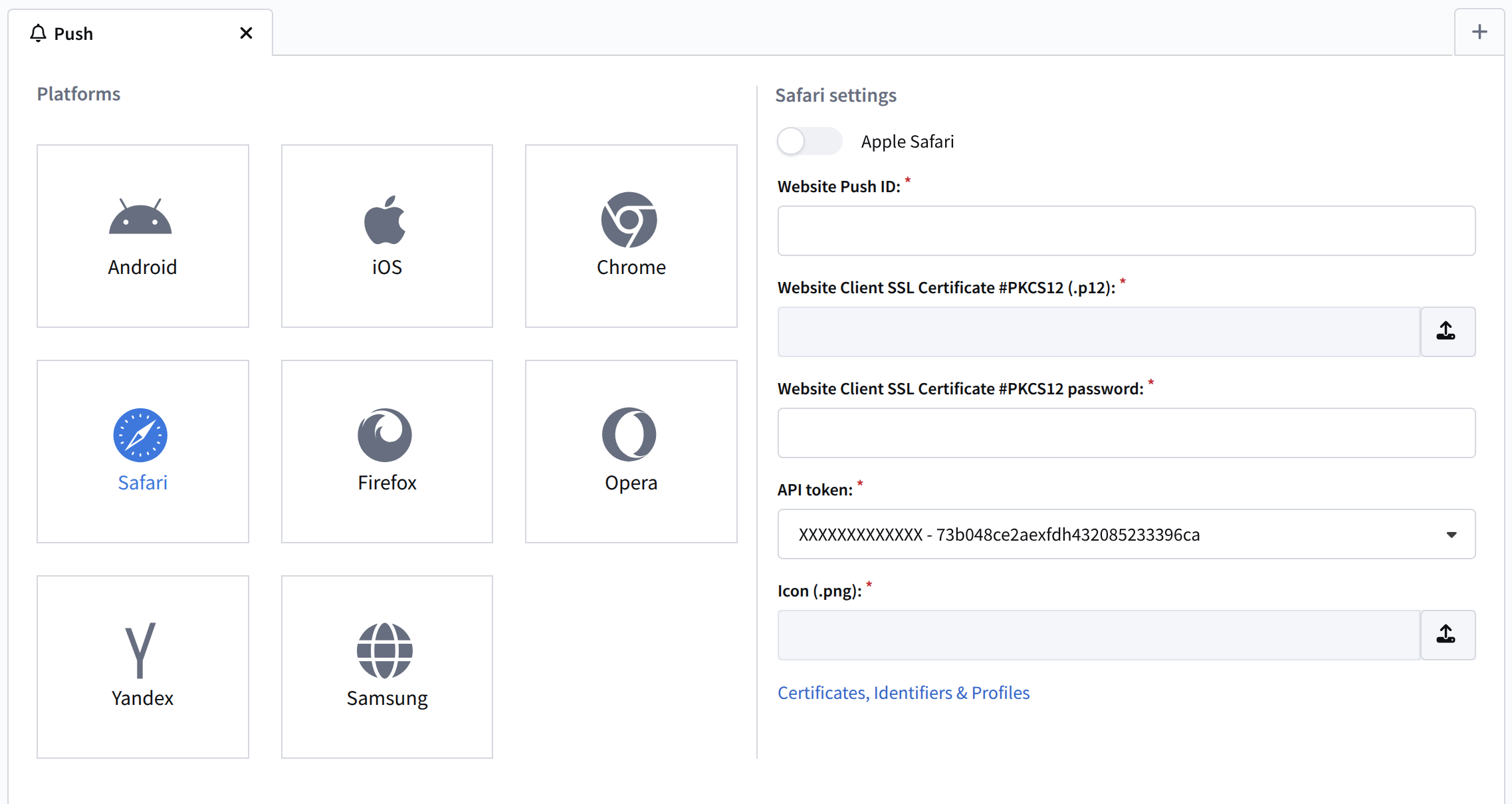
Select the Safari platform and activate the Apple Safari service.


Fill in the fields:

  • Website Push ID
  • Website Client SSL Certificate #PKCS12 (.p12) — the .p12 certificate file exported from Keychain Access
  • Website Client SSL Certificate #PKCS12 password — the password set when exporting the .p12 file
  • API token — the platform token from Settings — Tokens. If the token is deleted, the platform will stop accepting subscriptions from Safari for this resource
  • Icon (.png) — the image displayed in the push notification. Recommended size: 256×256 pixels or larger. Safari supports only one image per resource.

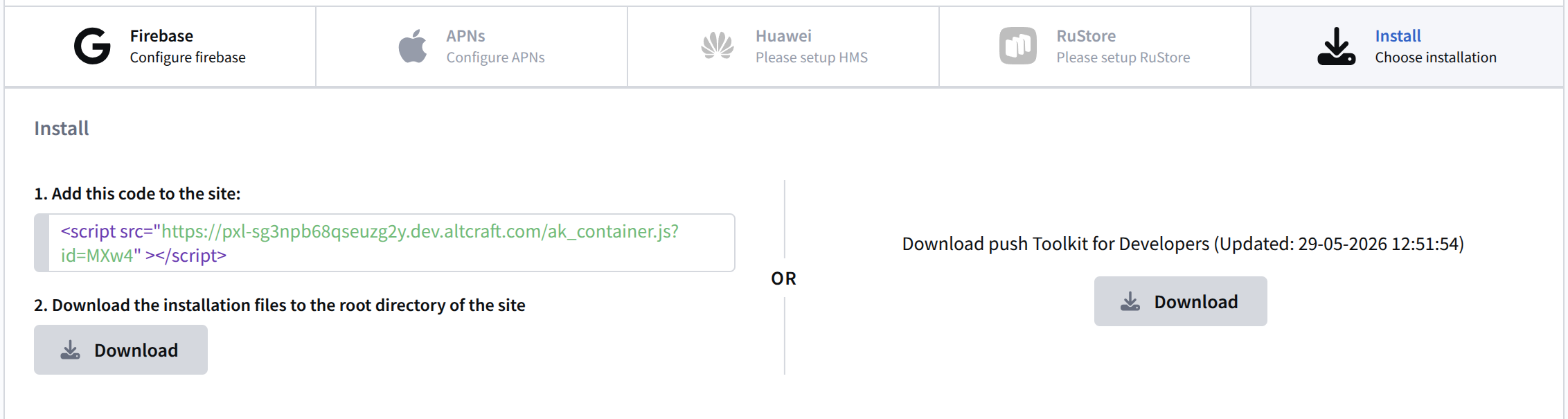
Save the resource or apply changes using the buttons in the upper right corner of the screen. Only after that, go to the Installation tab.

Further actions are described in detail in this section of the push configuration article.

Push in PWA

The resource and provider configuration for sending push notifications to PWA applications is done in the same way. For more details, see the article PWA Push.

Last updated on Jun 2, 2026
Previous
Firebase Cloud messaging
Next
Mozilla Services
  • Step 1. Register Website Push ID
  • Step 2. Creating a Certificate
  • Step 3. Saving the Push Certificate
  • Step 4. Setting Up in the Altcraft Platform
© 2015 - 2026 Altcraft, LLC. All rights reserved.