Subscriber profile
Description
Information about mailing recipients — customers, partners, mailing watchers — is stored in profiles organized in databases. Profile database determines the structure of general and custom data fields of each profile. Resources make communication possible.
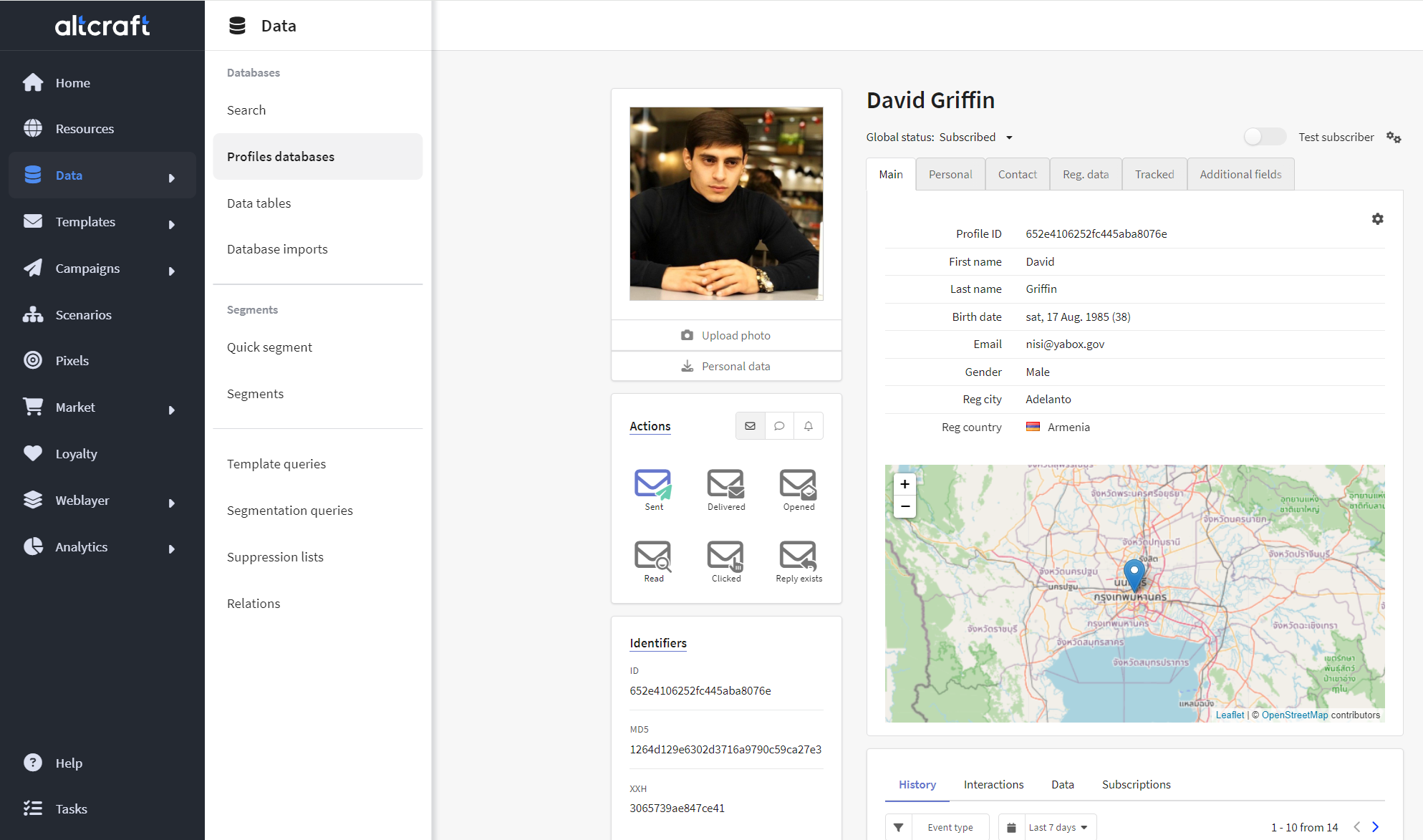
Subscriber profile combines several data types. Static data is displayed on the main page and is organized into several tabs. Other information is displayed below and contains:
- History — events, connected to this customer: mailing and browsing action history.
- Interactions — profile participation in static segments and automation scenarios; you can manually send a profile to a scenario, add to a segment or run a trigger mailing.
- Data — information about promo codes, orders and relations of the profile, as well as a list of forms he or she filled out.
- Subscriptions — profile's subscriptions to various Resources.
Avatar and data export
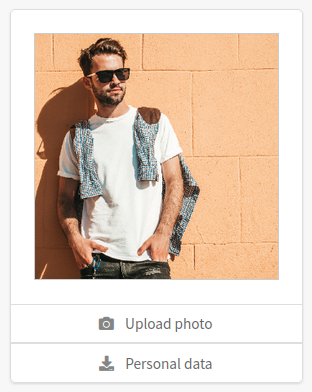
The top left side of the profile page contents your client's avatar and buttons that help you change it manually or export profile's personal data.
Global profile status
Global profile status is defined by the ability to communicate with customers through any communication channel. Individual subscription statuses depend on global status. If the profile has several active subscriptions, but its global status does not allow communication, a message will not be sent. 7 subscription statuses are available:
- Subsribed — available for communication by all channels
- Unsubscribed — unsubscribed from receiving messages by all channels
- Complainer — reported to Spam. Communication is stopped.
- Hard bounced — the provider completely refused to accept messages to this address. Most likely mailbox does not exist and attempts to send something will decrease your reputation. Invalid addresses are recorded in the global suppression list.
- Unconfirmed — subscriber registered but did not confirm his consent to receive messages. It is used with Double opt-in subscription. After confirmation, the status is changed to Subscribed.
- Suspended — subscription is suspended for some time.
- Invalid — excluded for marketing mailings due to other reasons.

Profile data
- Main — general information and location pin. Pressing a cog button will allow you to add or remove fields to customize tab appearance.
- Personal — customer's demographic data.
- Contact — customer's basic contacts.
- Reg. data — opt-in information.
- Tracked — IP and location of the latest transaction.
- Additional fields — custom database fields containing business information.
Email and Phones fields in the Contact tab are used to identify profiles in the database. Marketing mailings use resources.
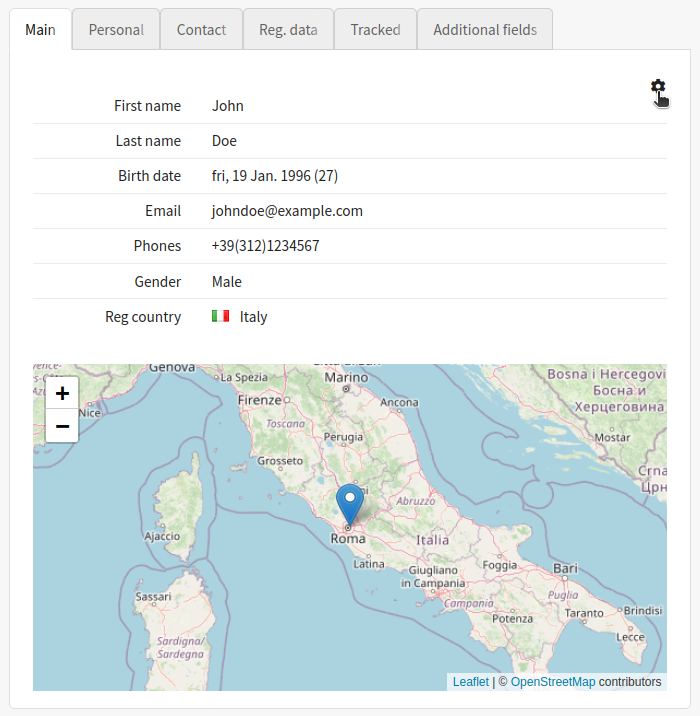
Subscriber location data can be set manually. Two types of default fields are used for this:
Latest action data — Country, Region, ZIP code, Timezone
Registration data — Reg Country, Reg City
Location in Altcraft Platform is identified automatically using the subscriber's IP address. This happens when customers open letters, click links or perform actions on a website. Geographical coordinates are displayed on the built-in map widget.
Automatic location is also available during profile import. For registration data, Reg IP field is used. Auto-detection option must be activated beforeimport from file. For API import, this option is enabled by default.
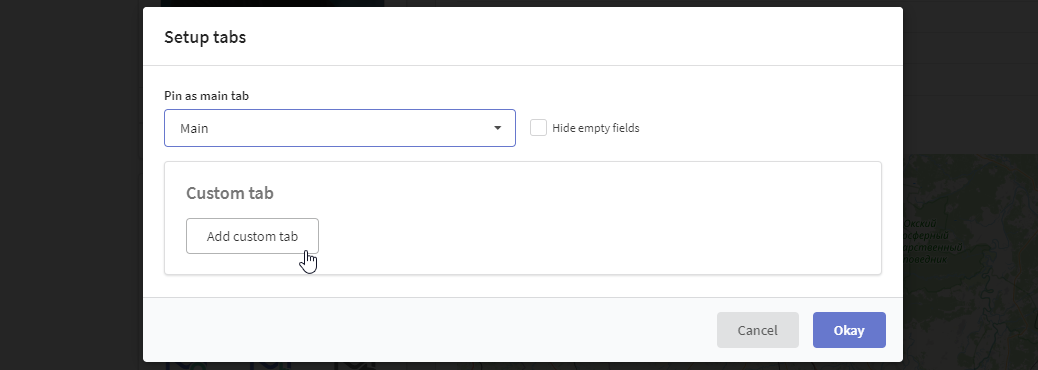
Whenever you open a customer profile - the main tab will be displayed by default. To customize it press the cogs button on the right:
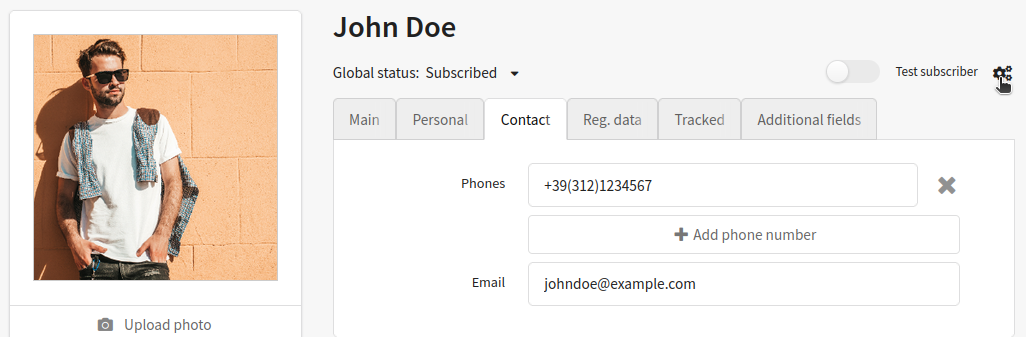
Select a tab to be displayed by default - or create your custom tab and customize data to be shown:
Custom data fields are created to store business-specific customer information. Thesefields may contain 8 types of data:
- Number — positive and negative integer numbers.
- Float — floating-point number: it has a decimal place.
- Line — text in any language, including numbers, special characters, spaces.
- Date — date in RFC 3339 format, like
2019-08-22T00: 00: 00.000Z. - Boolean — thisfield provides a choice of two options: True or False (Yes or No). It is used to define if the customer has a certain attribute, like VIP status.
- Enum — this field is similar to Boolean, but allows you to choose one option from the unlimited number of options created by the user. For example, customer tariff plan. Options are written in a comma-separated line.
- IP — IP in IPv4 format. For example,
127.0.0.1. - Tags — in thisfield, several values can be written simultaneously. They may be products or services purchased by a customer, or other values, composition of which may vary. Tags are written inline, separated by
",""|"or";". Therefore, these characters can not be used in the tag itself. For exampleProduct-1,Product 2,Product_3.
Custom fields are configured in the profiles database structure.
You can find detailed information about the types of fields in the database and the allowed values in this article.
History
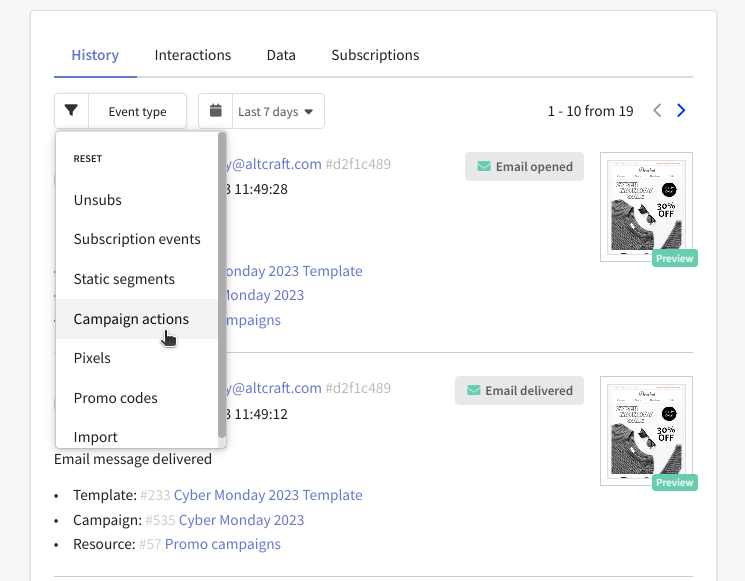
Profile's action history collects all the events connected with the profile. It can be used in behavioral segmentation:
- Import. How the profile was added to the database (manually, via API import, import from a file, push import).
- Subscription events. The profile was subscribed to a specific channel of the resource (Email / SMS / Push / Telegram / WhatsApp* / Notify / MAX / custom channel), or the profile was unsubscribed from the channel in the resource by changing the subscription status to "Unsubscribed".
- Mailing actions. Includes key events tracked in mailings (Sends, Deliveries, Opens, Reads, Clicks, Confirmation Link Clicks), as well as change of subscription status to "Hardbounce" or "Complainer".
- Unsubs. Unsubscribe events that are fixed when a profile clicks on an unsubscribe link in a message.
- Pixels. The profile performed an action on the site or in the mobile app that triggered the tracking pixel. The achievement of the goal and its cost are fixed.
- Promo codes. Includes events such as promo code attached, detached or activated.
- Static segments. The profile entered or exited a static segment.
To check a specific event type, use a filter. When you click on    the conditions in the filter will be reset.
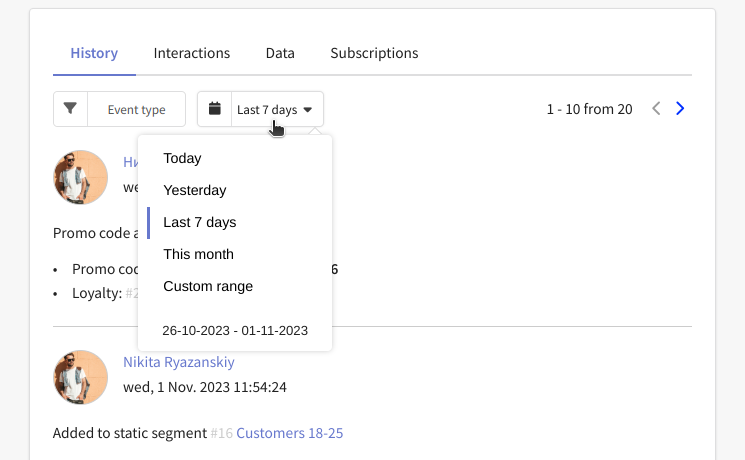
By default, profile activity history is displayed for the last 7 days, but you can select the period you need:
When the subscription status changes (in the interface, via API, or during import), events are registered only for the following statuses:
- Subscribed
- Unsubscribed
- Complainer
- Hardbounced
When the status changes to Subscribed, the event is registered only if the previous subscription status was Unsubscribed, Complainer, or Hardbounced.
For example, if the subscription status is set to Suspended and then changed to Subscribed, the event will not be registered.
Events are not registered for the following statuses:
- Unconfirmed
- Suspended
- Invalid
Interactions
Segments
Static segments are used for advanced analytics of customer fixed groups. There is a ready-made integration to export static segments data via SQL. Here you can add the profile to a segment or remove.

Triggers
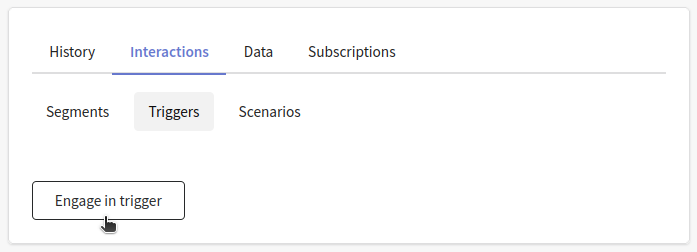
Triggers are mailings that are launched when a certain event occurs (the profile clicks on a link, fills out a form, etc.). On this tab, you can manually send a trigger message to a profile.
Scenarios
Scenarios help you automate your marketing workflows. This tab contains the history of a customer's scenario participation and results. And you can engage a customer in a scenario - manually.

Data
Promo codes
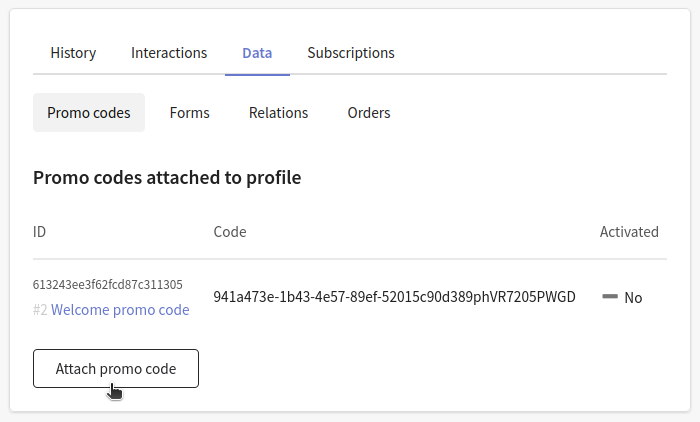
Promotion codes can encourage deals and they can be managed by Altcraft Platform loyalty programs. On this tab all the relevant information is displayed. You can manually assign a promo code as well.
Forms
Forms are a tool for collecting data from your customers. With its help, you can implement various mechanisms using external data, for example, add new profiles to the database, manage subscriptions to various resources, and receive feedback from customers.
On this tab, you can see which forms the profile has already filled out. When you click on the collected data, you will be taken to a new window that displays all the data left by the profile in the form.

Relations
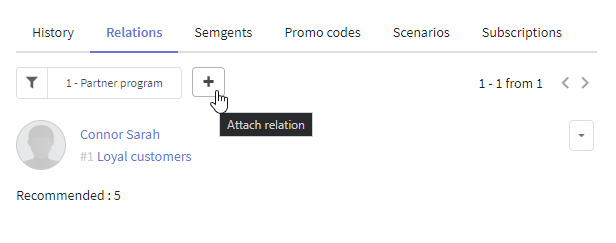
Relations between profiles can be used to register interactions between your clients — likes in a social network or service recommendations can serve as examples here. On this tab you can add a relation manually.
Orders
Orders are an element of the Market module. This module allows you to import product and order data to the platform and use this data to communicate with profiles. To activate this module, you must configure the appropriate access roles.

Pixels
A pixel is an HTML or JavaScript code placed on a website or in an application designed to track user actions. When a subscriber performs a specific action on the website or in the application, a request is sent to the server to record this action.
The pixel can also transmit information related to this action, such as the achieved goal, the value of the action, the URL of the website from which the subscriber came, profile geodata, information about sent mailings, and more. These data are recorded in the profile history and used for segmentation.

To view the data passed in the pixel_data object, press </> to the right of Data.
Goals can be registered for clients whose contact and personal information you do not yet have. Such events are called anonymous. Altcraft distinguishes them from each other based on connection data (cookies). If a client later registers using the same browser, their data is added to the already existing profile.
Profile subscriptions
Profile subscription is a record that combines contact data for a specific communication channel and information about registration. Every profile can have a number of subscriptions grouped by resource - the source of subscription. Every profile has a limit of 200 subscriptions or 20 subscriptions per resource in a channel. Also, different resources can use different contact information. For example, if a customer unsubscribes from one resource, they will continue to receive content from another resource.
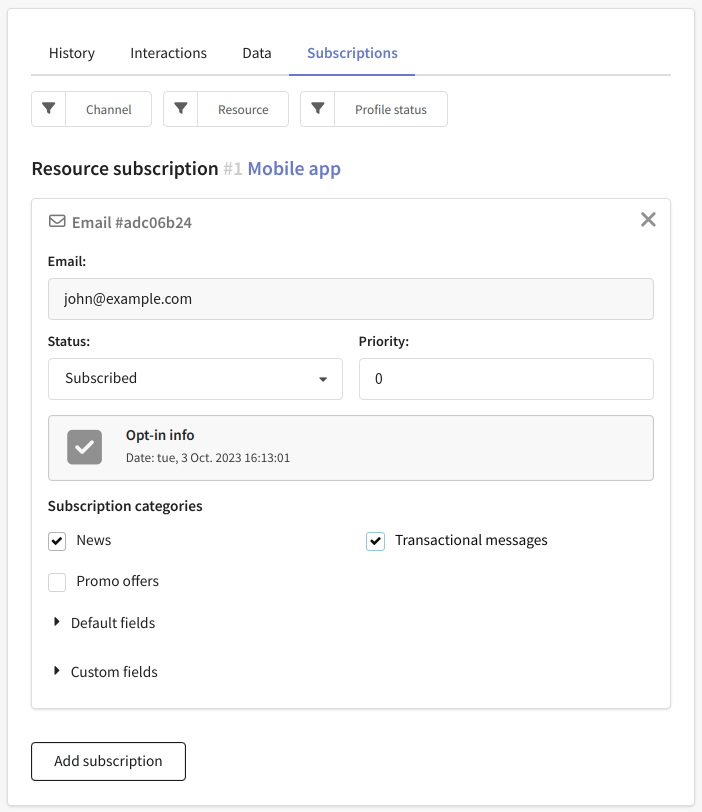
Here you can manually change subscription status and priority:
Status
Subscription status defines communication possibility with a customer by specific contact data within a specific resource. Here, like for global profile status, there are 7 types:
- Subscribed — available for communication by all channels
- Unsubscribed — unsubscribed from receiving messages by all channels
- Complainer — reported to Spam. Communication is stopped.
- Hard bounced — the provider completely refused to accept messages to this address, most likely the mailbox does not exist and attempts to send something will spoil your rating with the provider. Invalid addresses are recorded in the global stop list of the platform.
- Unconfirmed — the subscriber registered but did not confirm his consent to receive the newsletters. It is used with Double opt-in subscription. After confirmation, it changes to Subscribed.
- Suspended — subscription is suspended for some time.
- Invalid — excluded for marketing mailings due to any other reasons.
Priority
A user can subscribe to one resource several times by entering different contact details (email or phone number). The higher the value in the Priority field, the lower the priority of the subscription.
In the example below, mailings within the "Website" resource will be sent to test2@example.com, because a subscription with these contact details has the highest priority — 0.

You can increase the priority of a subscription automatically. To do this, activate the option in the resource settings.

Please note that the "Increase priority for new subscriptions" option applies only if the priority is not explicitly specified when adding a new subscription. If the priority of the new subscription is explicitly specified (for example, in an API request), then the priorities of existing subscriptions remain unchanged.
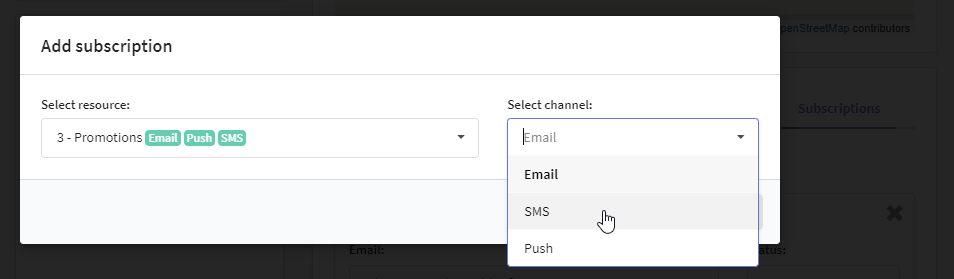
If you want to subscribe a customer to a resourse manually, press the Add subscription button, specify a resource and a channel, enter contact data and save your changes:
The subscription process (opt-in) can be organized in two ways:
- Single opt-in (SOI) - Without an agreement to receive content. It is enough to receive customer information (or create a subscription to a resource in Altcraft).
- Double opt-in (DOI) - Creating a subscription is not enough. Customers must send an email confirming their agreement to receive messages. This process allows you to exclude potential complaints from customers on marketing mailings, increase their effectiveness and improve sender reputation.
Click here to find instructions on how to organize Double opt-in subscriptions in Altcraft.
Subscription categories
A resource subscription can include multiple categories. Categories enable personalization of offers. The client will receive messages only within the categories to which they are subscribed.
Unlike a subscription to a resource, a subscription to a category has only 2 statuses: "Subscribed" and "Unsubscribed". To subscribe a profile to a category, check the appropriate box. You can also manage category subscription status via API requests.

Channel subscription fields
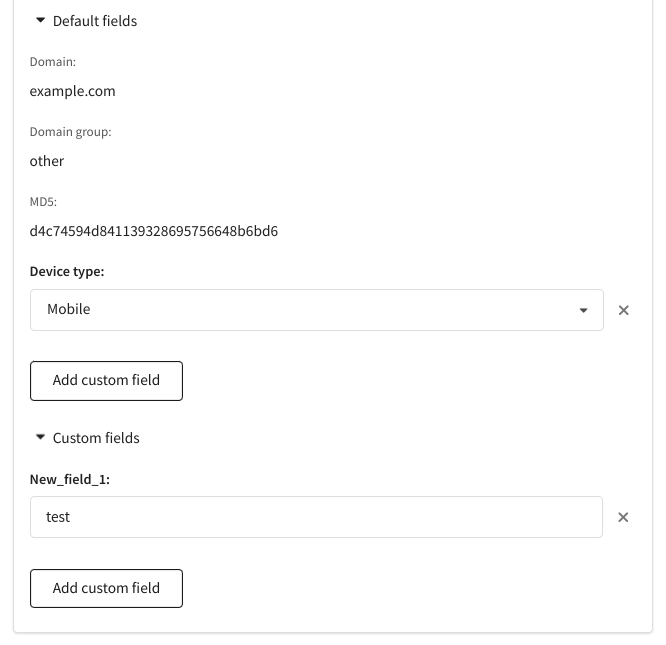
Data about a profile's subscription to a specific channel is stored in standard and custom fields.
You can also include additional standard fields that store information about the device and profile application:
- Device type (Desktop, Mobile, Other)
- Device model
- Device name
- Platform (Windows, Linux, Mac, Opera, iOS, BlackBerry, Android)
- Platform version
- Platform time zone
- Platform language
- Ad tracking allowed (True or False)
- Platform language
- Ad identifier
- Application ID
- Application installation ID
- Browser: Bots, Internet Explorer, Firefox, Safari, Facebook*, Chrome, Opera, Outlook, Thunderbird
- Application version
- Browser version
To add a new field, click the Add custom field button and select a field from the list, then enter its value.
To store additional information about your channel subscription, use custom fields. They are created in resource settings.
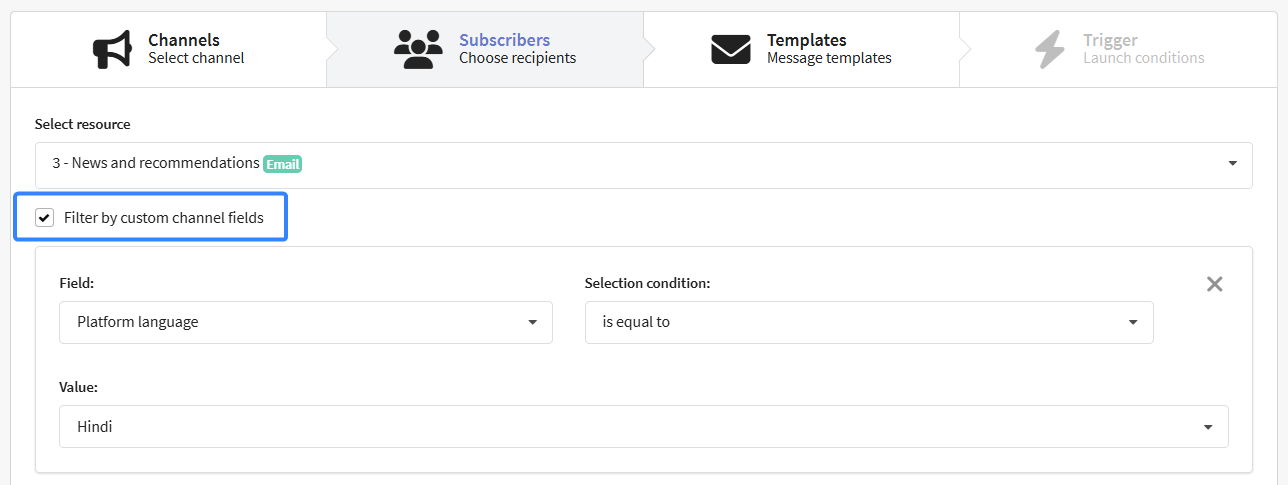
You can use them to filter the recipients of a trigger mailing. This will make the mailing more personalized.
Subscriptions Limit
There is a subscriptions limit for a profile. A profile can have no more than 200 subscriptions, or no more than 20 subscriptions per resource in a channel. If the maximum number has been reached, a new subscription will replace one of the old ones.
The following categories of subscriptions are being removed at first place:
- All deleted subscriptions
- All subscriptions with statuses:
- Invalid
- Hard bounced
- Complainer
- Suspended
- Unconfirmed
- Subscriptions with the lowest priority
- Oldest subscriptions by creation date
If you try to add replaced subscription, the platform will consider it a new one and re-add it to the list of subscriptions.
Loyalty programs
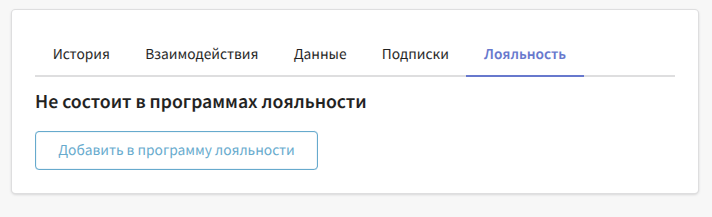
This section displays information about a profile’s participation in loyalty programs. If the profile is not enrolled in a program, you can register it:
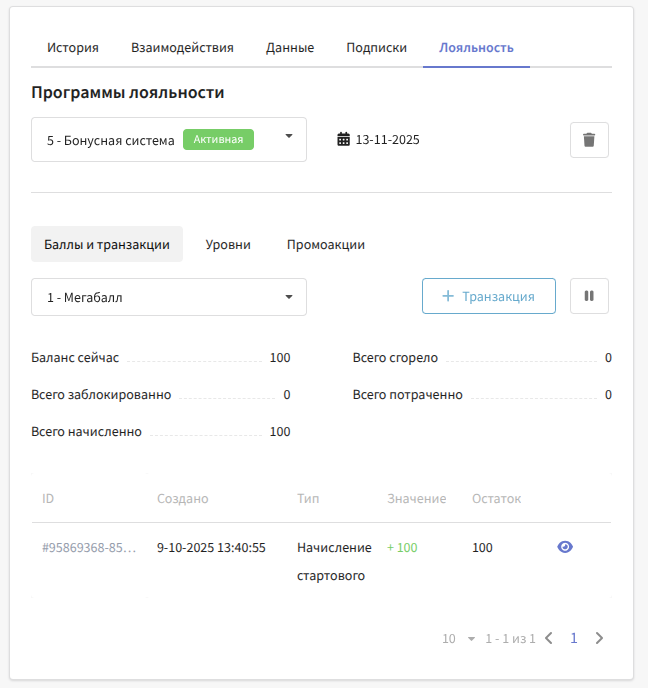
If the profile is already registered in one of the loyalty programs, this tab shows the profile’s points and transactions, its tier in the loyalty program, and participation in the program’s promotions. From here, you can also perform points transactions for the profile:
Identifiers
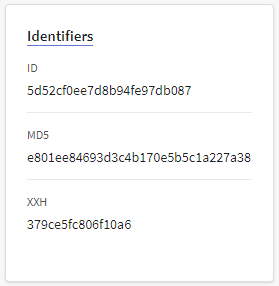 | Every subscriber profile in Altcraft Platform has a unique profile identifier profile_id — for all databases. It also gets unique MD5 and XXH identifiers. Within a database, the standard Email field is unique for profiles. However it is not required:if email address is missing, a new profile will get a profile_id@localhost record. |
UTM
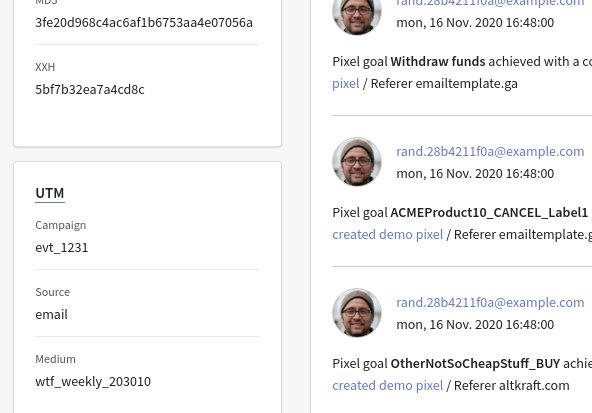 | UTM tags are updated in the subscriber's profile if they clicked on a link with UTM tags in the message template or submitted a form with configured UTM tags (the "Update UTM data to profile" option is enabled in the form). |
Participation in the control group
If the client profile is currently in the global control group, the corresponding mark will appear in their profile:
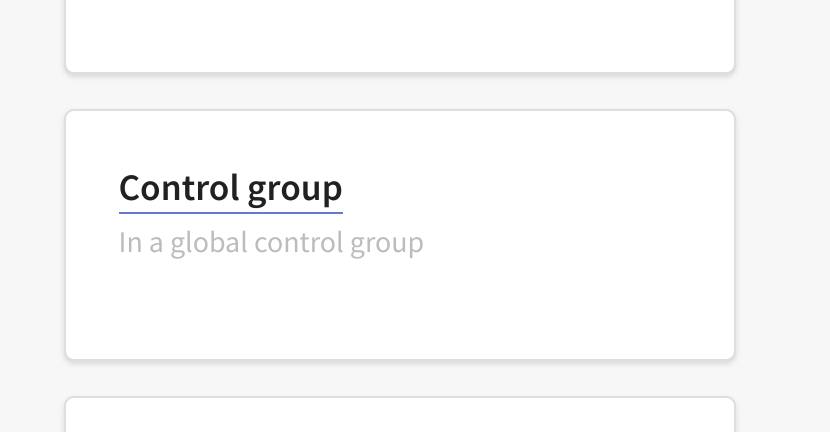
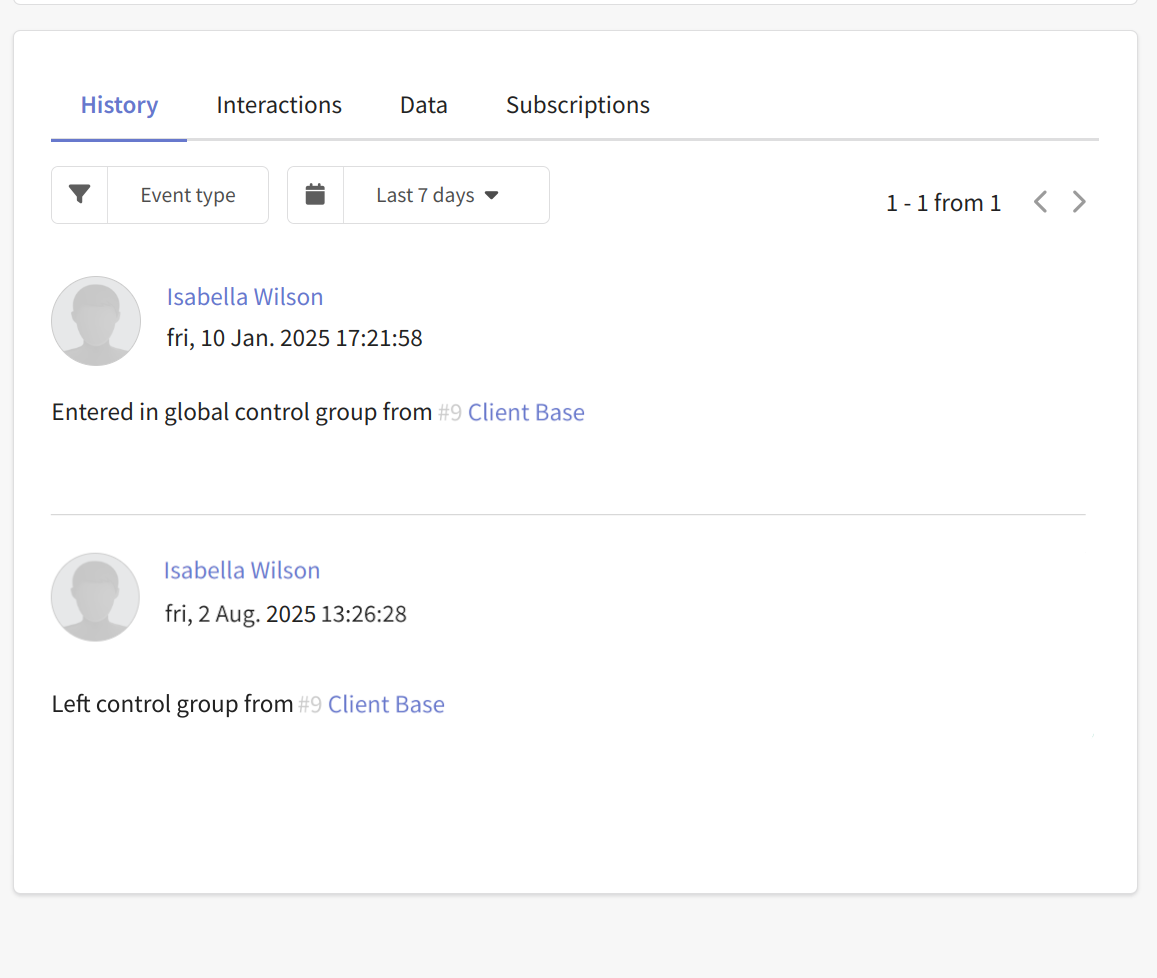
Also, the action history will show every time it gets in the GCG:
 |
Deleting profile
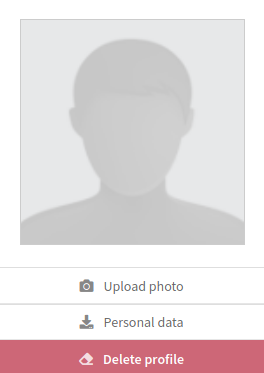 | If you need to delete a profile from the database, you can do it using the "Delete profile" button. This action will also remove profile actions history and relations. |
Special permission is necessary for deleting profiles. It can be configured in the user roles. You can read more about roles here.

You can also use an API request to delete a profile (see more).
*The Meta organization, which owns Instagram, Facebook and WhatsApp products, has been declared as extremist and banned in Russia.