Altcraft Docs LogoAltcraft Docs Logo
User guide iconUser guide
Developer guide iconDeveloper guide
Admin guide iconAdmin guide
English
  • Русский
  • English
Login
    Getting StartedAdministrator documentationFunctional characteristics
      Technology descriptionarrow
    • Architecture OverviewComponent Description
        Deployment schemesarrow
      • Basic schemeFail-safe schemeTypical Placement in Infrastructure
    System requirements
      Admin Panelarrow
      • Account areaarrow
        • Accountsarrow
        • Account UsersAccount Virtual SendersAccount Database Indexes
        TariffsExternal data configurationLDAPTasksSchedule JobsGlobal Stop ListsWebversion Store Policies
        Settingsarrow
      • Databases
          Accessarrow
        • AdminsAPI tokens
        Notifiers
          MTAarrow
        • Default rulesRetry rulesLock rulesBounce patternsStrategiesKeysISPsPools
      Nodes
        Sendersarrow
      • EmailSMSEvent generatorIntegration with SendsayENS: настройка сендера
        Reportsarrow
      • Audit JournalData Usage
        Toolsarrow
      • ARF decoderURL decoderSMID decoderLicense
      Platform installationarrow
    • Automatic installationManual installationRunning the platform in a Docker container
      Platform configurationarrow
    • Configuration fileDomain settingsLDAP access configurationSending Email via SMTP relayPixel and push domain configurationCluster and Replication SetupSystem notifications configurationProcesses UNIX sockets configurationHTTPS ConfigurationMigrating from MongoDB Community Edition to Percona Server for MongoDBAdding sender IP addressesDeduplication request settingsPostgreSQL database for account dataProxy server settingsKeycloak Integration with AltcraftGetting HTTP service statusesConfiguration MongoDB logs rotation
        Configuration of system constants and directoriesarrow
      • Filtering bot actionsDirectory of gender markers
      Platform maintenancearrow
    • Personnel requirementsPlatform maintenance processesPlatform updatingPlatform service monitoringBackup and recoveryTransferring the platform to a new serverCreating, deleting, and populating tables for statistics in ClickHouseUsage of the aktool utilityUsers and directories engaged by the platform
      Custom channels guidearrow
    • OverviewCreating and configuring a channelEntity field configurationTemplate languageEntities
        Pipesarrow
      • Pipe: Basic ConceptsResultErrorsLogPackUnpackHTTP RequestStore SetStore GetSelectorSQLEventerScheduler
        Pipelinesarrow
      • Pipeline: Basic ConceptsMessageScheduleListenerModerateStop
      Extraarrow
    • System page customizationSend Message IDИнструкция по миграции истории в ClickHouseInstructions for migrating history to ClickHouseUtility for importing push subscriptions to Firebase projectUtility for importing push subscriptions to Firebase project
    Processing HTTP/HTTPS traffic
      Administrator APIarrow
      • Accounts admin apiarrow
        • Restricted accessarrow
        • Account Activation and DeactivationAccount Freeze and Unfreeze
        Get accounts listAdd a new accountDelete the account
        Account usersarrow
      • Update an Existing AccountAdd a new accountDelete a userGet a list of usersSending a Welcome Email
        Nodesarrow
      • Synchronize node MTA configurationGet nodes listGet node MTA statusActivate node MTADeactivate node MTA
        Senders admin apiarrow
      • Create or update AKMTA senderGet AKMTA sender informationAssign account to senderGet senders listDelete senderRestore sender
          Sender queuearrow
        • Get sender queue informationHold sender queueRelease sender queueClear sender queue
        Virtual sendersarrow
      • Get virtual senders listGet virtual sender informationCreate virtual senderUpdate virtual senderClone virtual senderDelete virtual sender
    Documentation Archive
  • Custom channels guide
  • Overview

Overview

A channel in AKMP is an entity that defines interaction with a subscriber (profile) through external integration.

Such interaction could be, for example, sending an SMS, a message to a CRM or to a social network community.

There are three types of channels:

  • Built-in (Email, SMS, Push) — channels are strictly described in the system code and cannot be configured;
  • System — channels whose settings are supplied with the system;
  • Custom — systems configured by the user (administrator).

System channels are specified in the json_consts/channels directory.

A custom channel is configured in the platform admin panel, in the Setup > Custom Channels menu.

The channel contains:

  • Channel name;
  • Unique numeric and unique string identifiers designed to store the channel attribute in events, data structures, etc. Cannot be changed after creation;
  • Type of communication: personalized or non-personalized;
  • Identifier of the system module that controls the channel or configures pipelines for interaction with external services;
  • Settings for events that occur in the channel;
  • Settings for data fields and their displays in platform entities (content).

Non-personalized or indirect channels are used in cases where interaction occurs with an indefinite set of profiles, or when there are no such profiles in the platform. When sending messages to that channel, only one content will be created per mailing, and it cannot use personalized information.

For a personalized channel (direct), the mailing will create messages for each profile. Accordingly, they can use information associated with a profile, its fields and other data. To send messages, you must have a profile on the platform.

The channel has the ability to set events that are reflected in AKMP reports, profile history, segments, etc. Each event is assigned unique string and numeric identifiers, a name, the color of the graph in reports and a reflection of the internal platform event (for example, deliv — message delivery). To reflect events not provided for by the platform, the custom type (custom event) is used.

Content and channel settings are specified through fields. Fields can be set for the following AKMP entities:

  • Template define message fields, such as the body of a text message or an image;
  • Resource define customization fields in the resource, for example, an API key available to the user, or an application icon;
  • Mailing define message fields and settings, such as an identifier for reporting;
  • Sender define settings on the sender, for example, an API key that is not available to the user, or an API URL;
  • Subscriptions define identifiers that associate a resource with a profile in a channel, for example, a user ID in CRM.

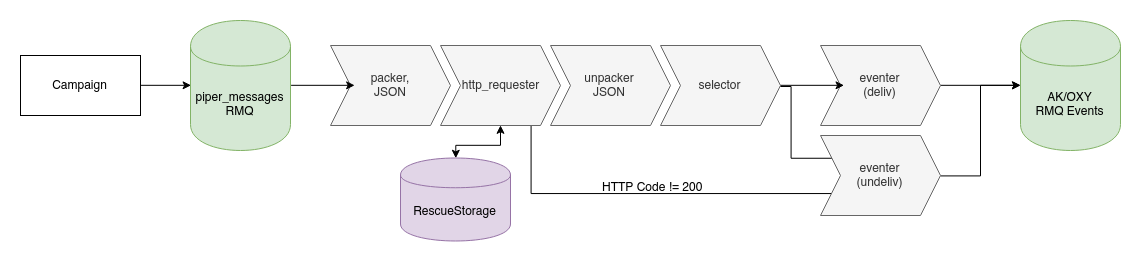
Interaction with external services when sending messages and receiving events on them occurs via pipelines.

Each pipeline consists of a JSON configuration in a special format that describes interaction with services: sending requests, converting data, saving and loading values, creating events in the platform.
Last updated on Nov 9, 2023
Previous
Custom channels guide
Next
Creating and configuring a channel
© 2015 - 2026 Altcraft, LLC. All rights reserved.